
There is a particular kind of manicure that stops you mid-scroll. It is not loud. It is not covered in glitter or stacked with charms. It is a quiet, pretty nail — a sheer pink, a soft French tip — with one small detail that changes everything: a tiny bow.
That is the whole appeal of coquette bow nails, and it is why they have become one of the defining nail looks of winter 2026. The bow is doing a lot of work for something so small. It reads as romantic without being childish, festive without being a Christmas novelty, and polished without demanding a full set of extensions or an afternoon at the salon. This guide breaks down the trend honestly — where it comes from, what it actually looks like in real life, and ten distinct ways to wear it, from the barely-there version to the full statement.
TL;DR: Coquette Bow Nails in 30 Seconds
- What it is: A manicure built around a bow motif — painted, sculpted, or attached as a small charm — usually on a soft pink, nude, French, or deep winter base.
- Why winter 2026: The coquette aesthetic — ribbons, satin, ballet references, soft femininity — has been a steady presence on Pinterest and Instagram through 2026, and bows are its most wearable nail translation for the party season.
- Easiest entry point: One tiny painted bow on each ring finger over a sheer pink or French base. It takes minutes and suits almost every nail length.
- Most grown-up version: A single matte black velvet or champagne gold bow on a nude nail. The contrast keeps it elegant rather than sweet.
- Best for: Holiday parties, winter weddings, date nights, and anyone who wants a festive nail without glitter.
- Skip if: You work with your hands all day and hate maintenance — 3D charms catch on things. Painted bows are the practical alternative.
What Are Coquette Nails?
Definition: Coquette nails are manicures inspired by the coquette aesthetic — soft, romantic, feminine styling drawn from ribbons, bows, satin, lace, and ballet — usually in a palette of blush pink, cream, nude, and white.
The word “coquette” itself has been around far longer than any social media trend. It describes a flirtatious, romantic style language: bows in hair, satin ribbons, delicate fabrics, a certain vintage softness. What changed in the last couple of years is that this language moved from outfits and hairstyles onto nails, and the bow became its signature motif. A bow is instantly legible — you do not need to explain it — and it scales beautifully, from a whisper of white paint to a dimensional pearl charm.
What Is the Evidence Behind the Bow Nail Trend?
Coquette bow nails are a real, observable trend rather than a passing novelty, and the evidence is in what you actually see when you browse nail content. Through 2026, bow motifs have appeared consistently across Pinterest boards and Instagram nail accounts devoted to soft, romantic manicures: painted bows on French tips, satin bows on sheer pink bases, pearl bow charms on bridal sets, and black velvet bows on nude nails for evening looks. Nail artists regularly pair the motif with winter-adjacent styles — velvet finishes, deep reds, champagne shimmer — which is why it feels current in the colder months rather than like a summer idea carried over.
It is worth being honest about what this trend is not. It is not a single design that everyone wears the same way, and it is not confined to one age group or one occasion. Its strength is exactly the opposite: the bow is a motif, not a prescription, so it adapts to short nails and long ones, to minimal tastes and maximal ones, to a Tuesday at the office and a December wedding. That adaptability is why it has lasted on feeds through 2026 instead of burning out in a single season.
It also fits the broader direction of winter nail fashion. Our winter nail trends guide notes the season’s move toward soft, wearable luxury — milky bases, quiet shimmer, and details that reward a closer look. A bow is precisely that kind of detail. It photographs beautifully, which matters for a trend that lives largely on Pinterest and Instagram, but it also looks good in person at normal distance, which is the test most trends fail.
How Do You Wear Coquette Bow Nails Without Looking Costumey?
The difference between pretty and precious comes down to restraint, and restraint here means three decisions: how many bows, how big they are, and what they sit on. The most wearable versions of this trend follow one simple rule — one bow motif per hand, or one per nail at most, on a calm base colour. A sheer pink, a milky nude, a classic French, or a deep winter shade lets the bow be the detail rather than competing with it.
Scale matters more than people expect. A bow that covers a third of the nail reads as a statement; a bow the size of a grain of rice reads as jewellery. If you are trying the trend for the first time, start small and on the ring fingers only. You can always add more next time. The same logic applies to colour: a white or ivory bow on pink is the softest version, while a black or red bow is a deliberate contrast that immediately looks more evening-appropriate.
Finally, think about finish. A glossy top coat keeps painted bows crisp and clean, while a matte top coat over a velvet bow design deepens the whole effect. If you are wearing 3D charms, a thicker top coat or a small amount of builder gel around the charm’s base helps it survive the week — and our guide to 3D nail embellishments for winter covers charm placement and wear in more detail.
10 Coquette Bow Nail Ideas for Winter 2026
Each idea below is a complete, distinct design — a different base, bow style, or mood — so you can pick one and take it to your nail artist, or recreate the painted versions at home.
1. The Classic: French Tips with a Tiny Painted Bow
If you only try one version of this trend, make it this one. A classic French manicure — sheer pink bed, clean white tip — with a single tiny white bow painted at the base of each ring finger is the most versatile bow nail in existence. It works for the office, for a wedding, for a holiday dinner, and for every outfit you already own, because it is essentially a French manicure with a secret.
The bow should sit near the cuticle, not in the centre of the nail, so it reads as an accent rather than a sticker. Keep the loops small and the tails short — two short ribbon tails are enough. On almond or oval shapes this design looks especially graceful, since the tapered tip echoes the delicacy of the bow. If your nails are short, the same idea works; just shrink the bow further and keep the French tip slim rather than deep.
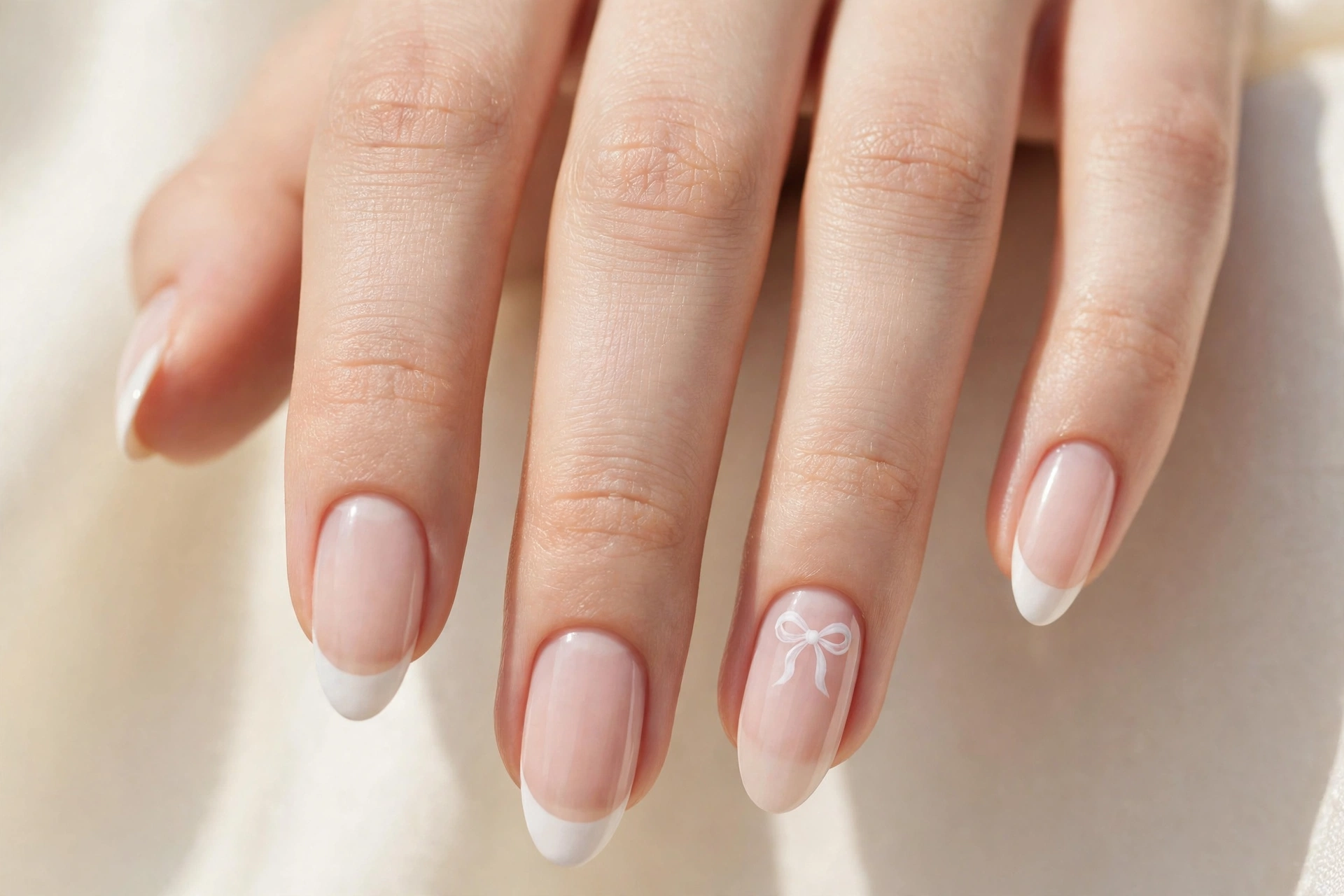
French tips with a tiny painted bow — the most versatile version of the trend.
2. Blush Pink with Hand-Painted White Bows
This is the softest version of the trend and the one most often seen on Pinterest boards for romantic winter nails. A glossy blush pink covers every nail, and two accent nails — usually the ring fingers — carry a fine white hand-painted bow. The effect is gentle rather than graphic: from a normal distance it reads as a pretty pink manicure, and the bows reveal themselves up close.
The key to this design is the paint. A thin nail art brush and a true white, not an off-white, gives the bow its crispness against the pink. If you are painting your own, practise the bow on a nail wheel or a piece of foil first: two loops, a small centre knot, and two short tails. Seal with a glossy top coat, and the whole set looks like it belongs in a ballet studio — soft, clean, and quietly romantic.
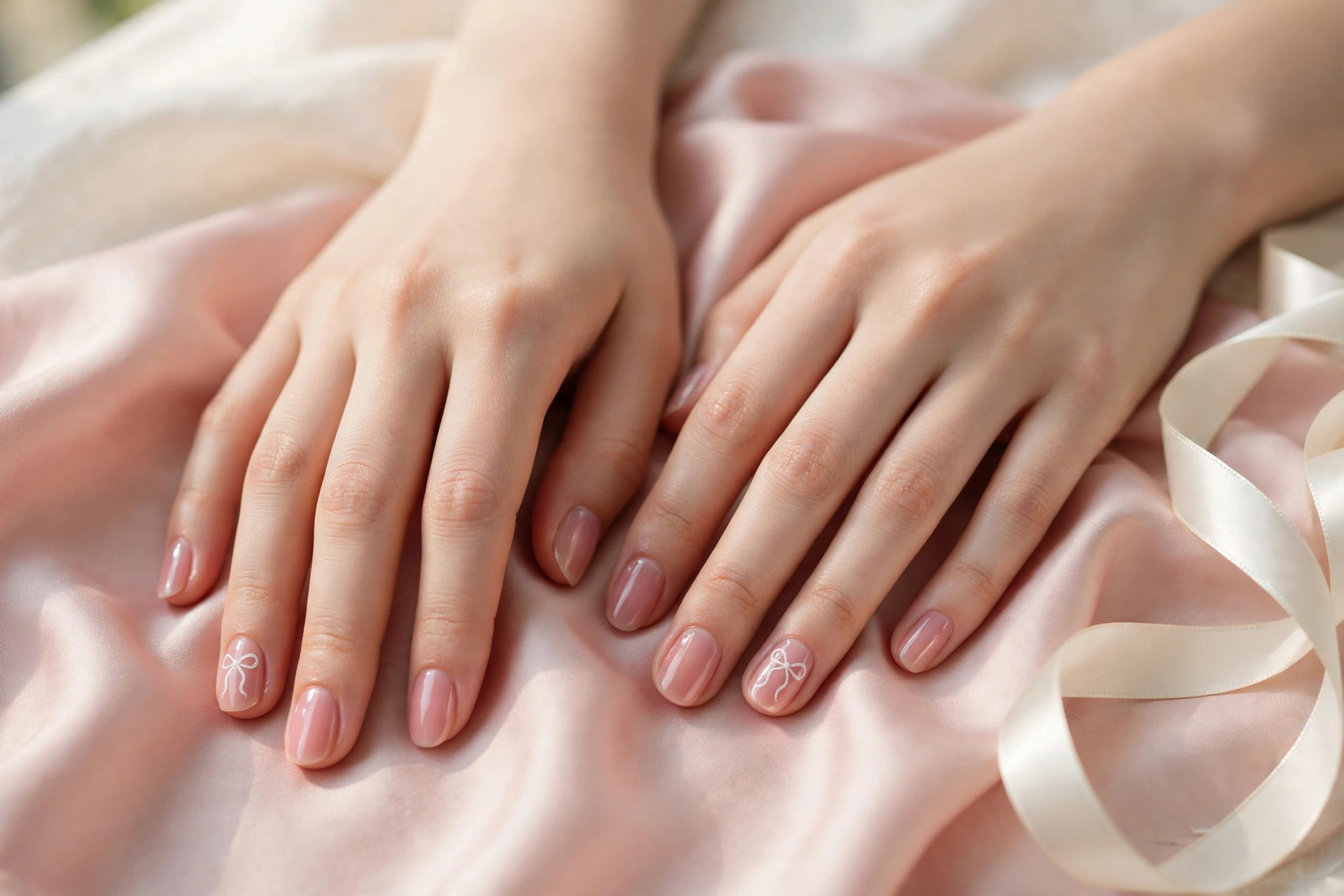
Blush pink with hand-painted white bows — soft, romantic, and easy to wear daily.
3. The 3D Pearl Bow Charm
For occasions when a painted bow feels too quiet, a three-dimensional pearl bow charm is the upgrade. A milky nude base keeps the focus on the charm, which sits on one accent nail per hand and catches the light every time you move. Pearl is the right material here: it is lustrous without being glittery, and it pairs naturally with winter’s softer palette of cream, champagne, and ivory.
This is a special-occasion design rather than an everyday one. Charms add height to the nail, so they can catch on knitwear and hair — worth knowing before a week in chunky sweaters. Ask your nail artist to anchor the charm properly and keep it to one or two nails per hand. Worn that way, it reads as jewellery, not decoration, and it is a beautiful choice for a winter wedding or a New Year’s Eve dinner. Our winter wedding guest nail guide has more ideas for occasion dressing in the same spirit.
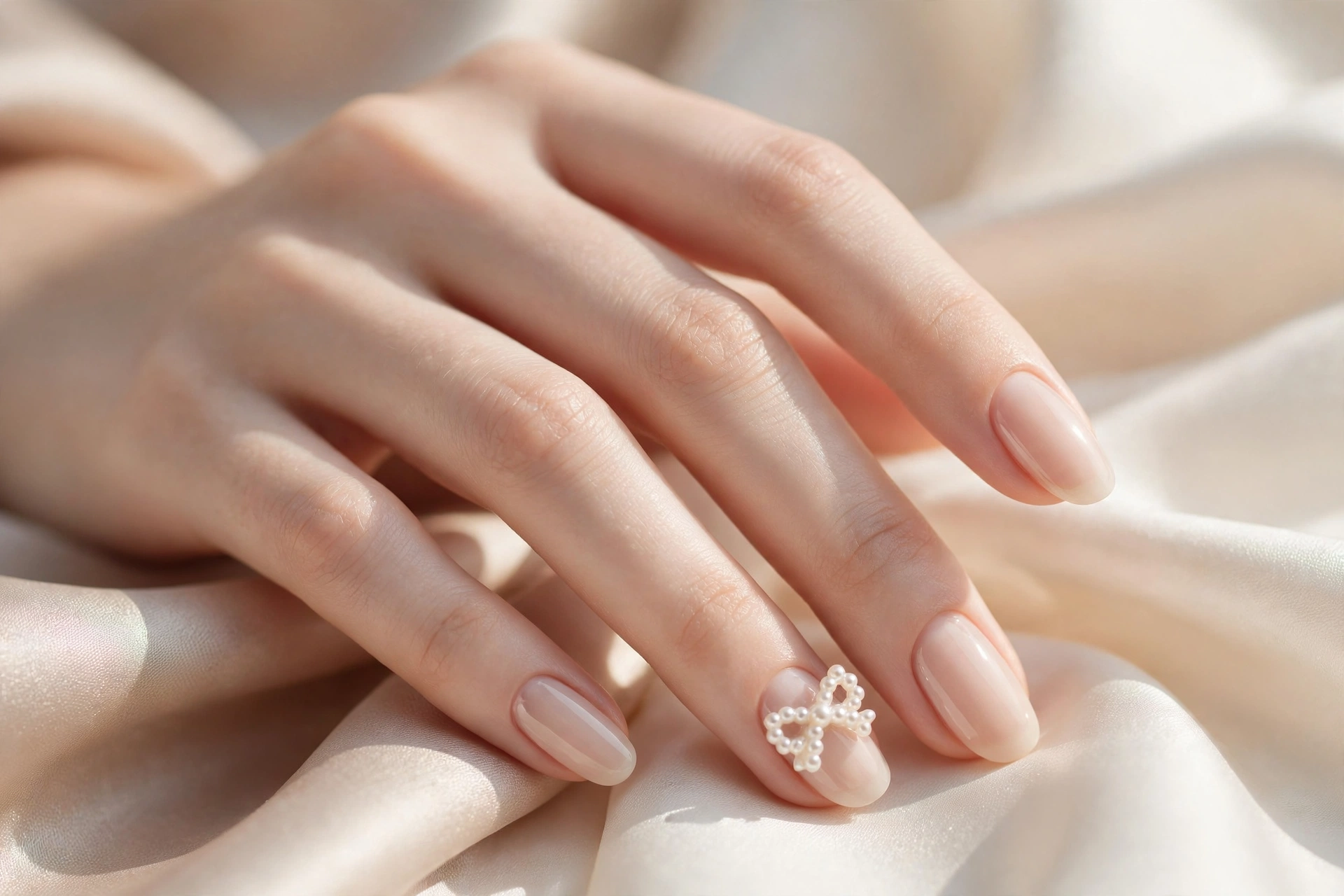
A 3D pearl bow charm turns a nude manicure into occasion jewellery.
4. The Holiday Red Ribbon Bow
Red is winter’s most reliable party colour, and a red ribbon bow is the most festive version of this trend without tipping into novelty territory. A deep, glossy red — think bordeaux or classic cherry rather than bright scarlet — covers every nail, and one accent nail carries a small red satin bow that matches the base almost exactly. The tone-on-tone effect is what keeps it elegant: the bow is visible through its texture and sheen, not through contrast.
This design earns its place at every December event, from a work party to Christmas dinner, and it pairs naturally with gold jewellery and a black dress. It also photographs beautifully next to wrapping paper and fairy lights, which is part of why it performs so well on Pinterest in the holiday weeks. If you want the festive feeling with slightly less intensity, swap the deep red for a softer cranberry and keep the bow small.
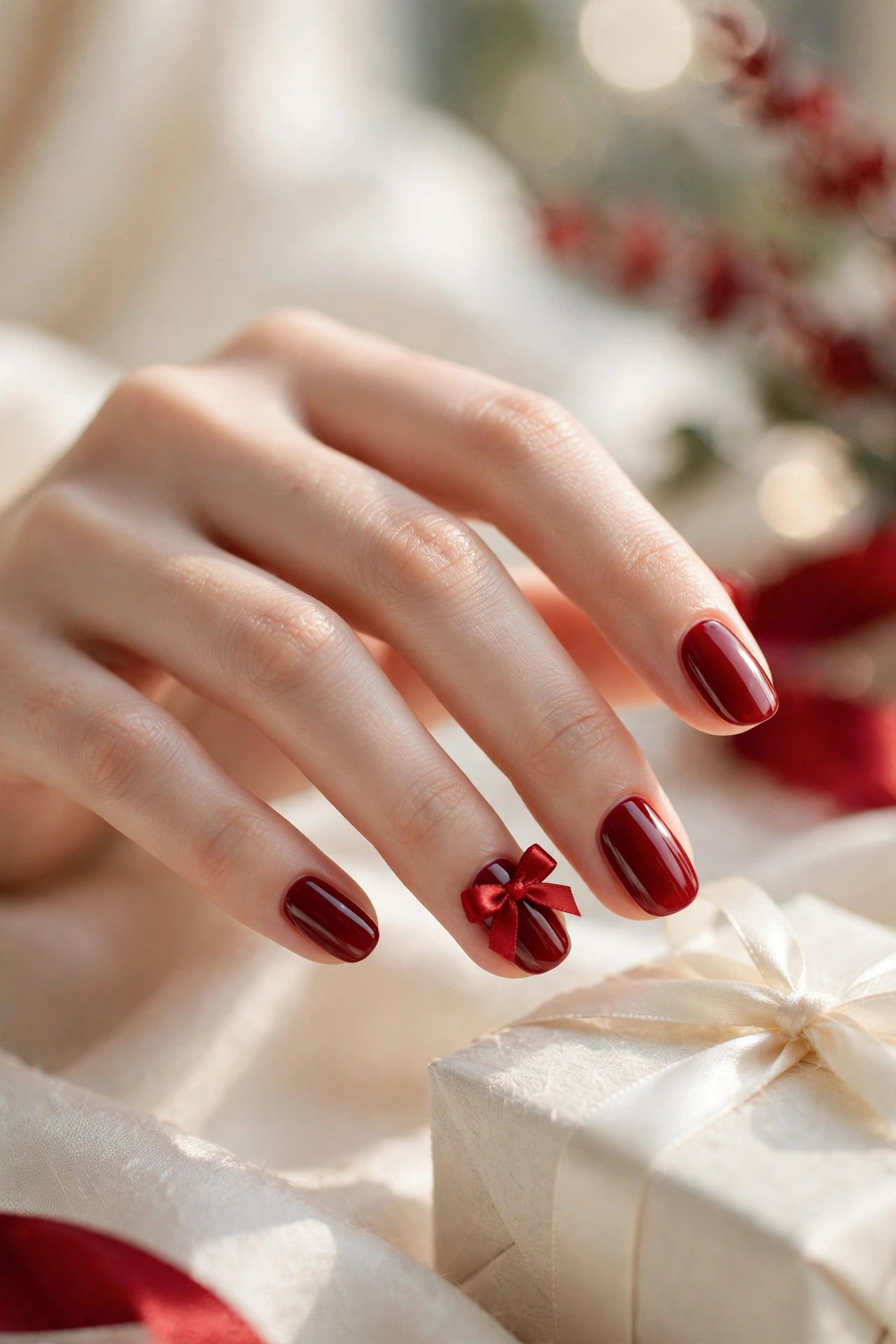
Deep red with a tone-on-tone satin bow — festive without being a novelty.
5. The Grown-Up Version: Black Velvet Bow on Nude
This is the version for anyone who loves the bow idea but does not love pink. A sheer nude base, almost your natural nail only better, carries a single small matte black velvet bow on the ring finger. The contrast between the barely-there base and the dark, textured bow is striking in a quiet way — it reads as deliberate and evening-ready, more cocktail party than ballet recital.
Black velvet works because it behaves like a fabric rather than a colour: it absorbs light, so the bow looks soft and dimensional instead of flat. Pair it with a black dress, a gold ring, or a velvet hair ribbon and the whole look coheres. It is also the most forgiving version for imperfect application, since a matte black bow hides small painting wobbles better than white does. For more dark, elegant winter ideas, see our velvet nails guide.

Black velvet on nude — the grown-up, evening-ready take on the bow trend.
6. Champagne Gold Bow for New Year’s Eve
Champagne gold is winter’s party neutral, and a tiny gold bow charm on a shimmering champagne base is the most celebratory version of this trend. The gold-on-gold combination sounds like it would disappear, but the opposite happens: the metallic bow catches light differently from the shimmer polish, so it stands out as a distinct shape against a glowing background.
Keep the rest of the set simple — the same champagne shimmer on every nail, no extra glitter, no rhinestones — and let the bow be the single detail. This is a natural New Year’s Eve choice, and it pairs with everything from a sequin dress to a satin slip. If you are planning a full party look, our holiday party nail trends and gold nails guide sit in the same world.

Champagne shimmer with a gold bow charm — made for New Year’s Eve.
7. Short and Sweet: Dainty Bows on Short Squoval Nails
Bow nails are not only for long almond shapes, and this is the proof. Short squoval nails — square with softly rounded corners — in a sheer milky pink carry tiny painted bows on the ring fingers, and the result is neat, practical, and completely charming. Short nails actually suit the coquette look well, because the small canvas forces the bow to stay small, which is where the design looks best anyway.
This is the everyday version: easy to type with, easy to maintain, and appropriate anywhere. It is also the best starting point if you keep your nails short for work or for sport. For more short-nail inspiration in the same spirit, our elegant short nail designs collection is a good next stop, and our nail shape guide explains how squoval compares with round and oval.
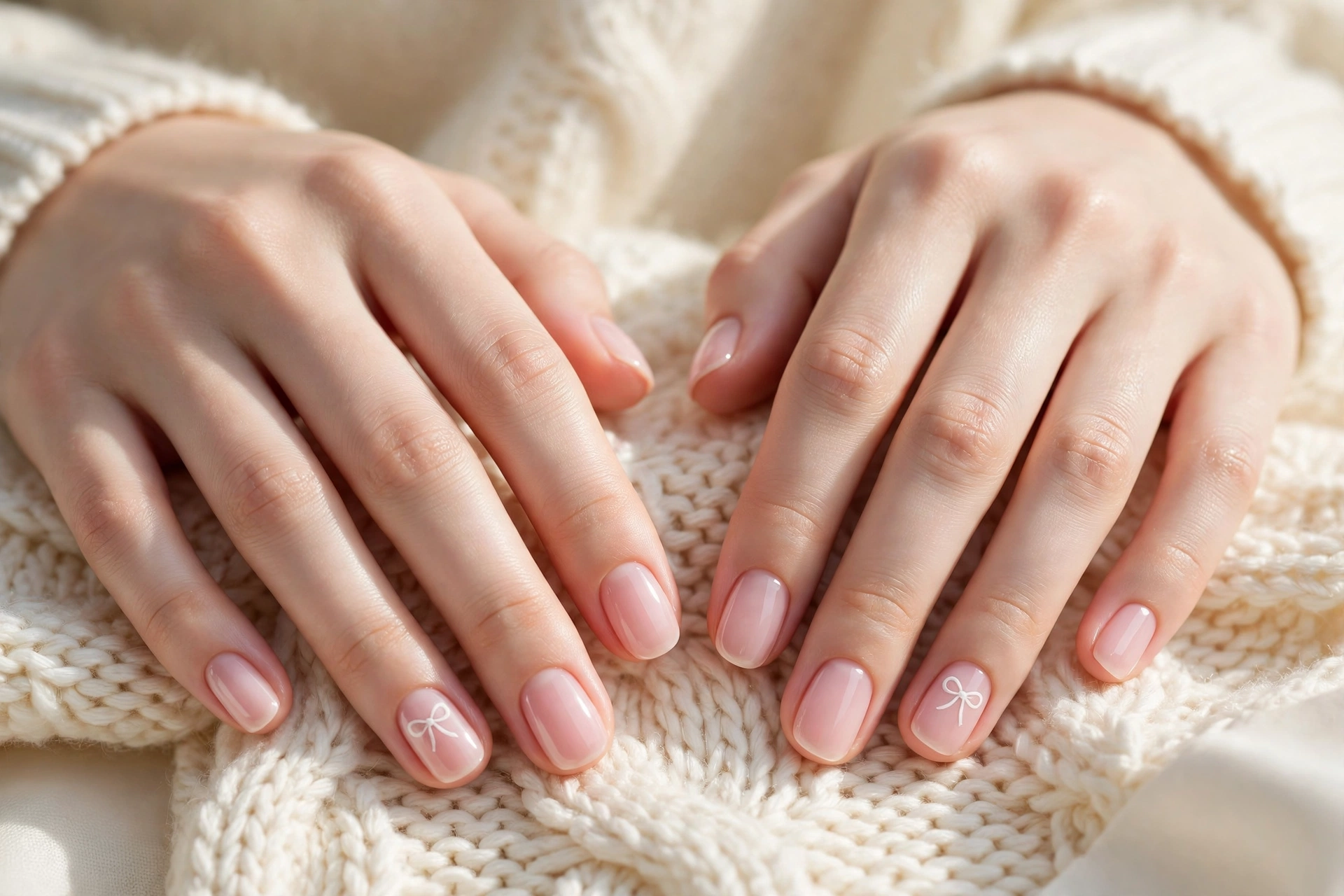
Short squoval nails prove bows are not only for long lengths.
8. Bow French Tips: The Bow Is the Tip
This is the cleverest variation of the trend. Instead of placing a bow on the nail, the French tip itself becomes a bow: each nail tip is shaped with two small loops and a centre knot in white, sitting on a sheer pink base. The effect is playful and graphic at the same time, and it reads as a fresh twist on the French manicure rather than a separate design entirely.
Bow tips demand a steadier hand than a simple painted bow, since the shape has to be consistent across all ten nails, so this is a good one to take to a nail artist rather than attempt freehand on your first try. Almond or oval shapes show the bow-tip shape best, because the curved tip gives the loops room to breathe. It is a wonderful choice for a bridal shower, a birthday, or any occasion where you want your nails to be a conversation piece.
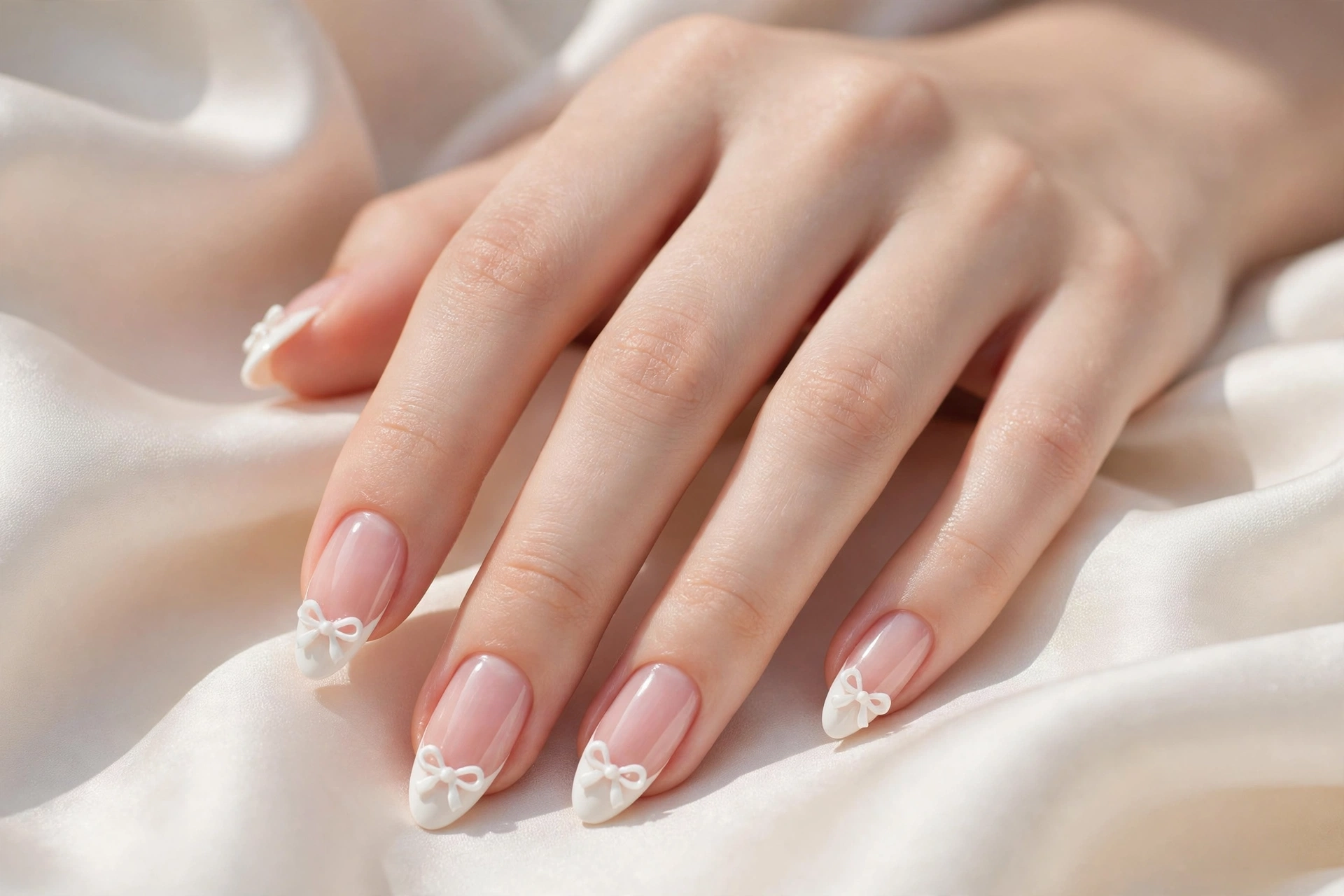
Bow French tips — where the tip itself becomes the bow.
9. Balletcore: Ribbon Lacing and a Bow
Balletcore and coquette are close cousins, and this design sits exactly where they overlap. A ballet-slipper pink base carries a delicate white ribbon-lacing detail — thin criss-cross lines like a pointe shoe’s ribbons — finished with a small bow on the accent nails. It is the most thematic version of the trend, and it works because the lacing is fine and the pink is soft; nothing about it shouts.
Wear this one with satin, cashmere, or anything soft and light-coloured, and keep jewellery minimal — a thin gold band or small pearl studs is enough. The lacing detail is best done by a nail artist with a striping brush, and it rewards a glossy top coat, which makes the white lines look like real ribbon. It is a lovely choice for a winter ballet performance, a baby shower, or a romantic dinner.

Ribbon lacing with a bow — balletcore and coquette in one design.
10. Espresso and Cream: The Winter-Morning Bow
Not every winter nail needs to be pink, and this design is the proof. A rich espresso chocolate-brown covers every nail, and one accent nail carries a small cream satin bow. The contrast is warm and appetising — coffee and cream — and it suits winter wardrobes full of camel coats, cream knits, and brown leather better than any pink could.
Espresso is also one of winter’s most flattering dark shades: it is softer than black, warmer than burgundy, and it makes the cream bow pop without any glitter. This is the version to choose if you want the trend but your style leans warm and earthy rather than pastel. Our chocolate brown nails guide explores the shade family in more depth.

Espresso with a cream bow — the warm, winter-morning version of the trend.
Which Bow Style Should You Choose?
The three main ways to put a bow on a nail look similar in photos but behave very differently in real life. Dainty painted bows are the easiest to live with, statement bows make the biggest visual impact, and 3D charms are the most eye-catching but the least practical. This comparison should make the choice straightforward.
| Bow style | Best for | Durability | Effort | Watch out for |
|---|---|---|---|---|
| Dainty painted bow | Everyday wear, work, first-timers | As long as your polish lasts | Low; doable at home with a thin brush | Needs a steady hand for symmetry |
| Statement bow (large painted or sculpted) | Parties, photos, special occasions | Good if sealed well | Medium; best done by a nail artist | Can look busy on short nails — keep it to accent nails |
| 3D bow charm (pearl, metal, satin) | Weddings, New Year’s Eve, bridal events | 1–2 weeks with proper anchoring; catches on knitwear | High; needs professional application | Snagging, and extra height on the nail |
A useful rule of thumb: if you are unsure which to pick, choose the dainty painted bow. It is the version you will still be happy with on day ten, and you can always graduate to a charm for a special occasion later.
What If You Want the Look, But Quieter?
Not everyone wants a visible bow, and the trend has room for that. If the full coquette look feels too sweet for you, there are several ways to nod to it without committing to it. A single bow on one hand only — usually the left ring finger — reads as a deliberate accent rather than a theme. A bow in the same colour as the base, like a blush bow on a blush nail, gives texture without contrast, so the design is felt more than seen.
Another quiet option is to move the bow off the nail and onto the styling: wear a plain sheer pink manicure with a satin ribbon in your hair or a bow ring, and you get the same romantic feeling without any nail art at all. Or choose the black velvet version above, which is already the quietest bow design in this guide — dark, matte, and restrained. The point of the trend is softness, not sweetness, and softness has many volumes.
Who Do Coquette Bow Nails Suit?
Bow nails are unusually democratic, but a few guidelines help you pick the right version for your hands. On nail shape: almond and oval shapes flatter painted bows best, because their tapered tips echo the bow’s delicacy; squoval works beautifully for the short, dainty versions; stiletto shapes can carry a bow but risk looking dramatic rather than pretty, so keep the bow small. On length: short nails suit tiny painted bows and the short squoval design; medium lengths handle every version; very long nails suit 3D charms, since there is room to anchor them without crowding the nail.
On skin tone: the classic palette — blush, cream, nude, white — is flattering across skin tones, but the base matters: deeper skin tones look beautiful with richer bases like espresso, deep red, or chocolate under a cream or gold bow, while fair skin tones glow with sheer pink and milky white. On occasion: painted bows suit every occasion from the office to a wedding; 3D charms are best saved for events, since they demand more care. And if you are choosing nails for a specific event, our Christmas market outfit and nail pairings and November nail trends roundups will help you place a bow design in a full winter look.
How Do You Ask for Coquette Bow Nails at the Salon?
Bring a reference photo — ideally of the exact version you want, not just “bow nails” generally, since the range runs from a grain-of-rice painted bow to a full pearl charm. Tell your nail artist four things: the base colour, the bow style (painted, sculpted, or charm), which nails carry the bow (ring fingers only is the classic choice), and the bow size relative to your nail. A useful sentence is: “A sheer pink base, almond shape, with a small white painted bow on each ring finger, kept dainty.”
If you are doing the painted versions at home, you need a thin nail art brush, a true white or cream polish, and patience. Paint the base and let it dry fully first — painting a bow onto a tacky base is the most common mistake. Practise the bow shape on foil before your nails: two loops, a centre knot, two short tails. Finish with a glossy top coat, and reapply top coat every two to three days to keep the bow crisp. If you want a charm version at home, press-on nails with pre-attached bows are a sensible shortcut, and they avoid the anchoring problems of glued charms.
Common Mistakes to Avoid
- Too many bows: A bow on every nail turns a pretty detail into a pattern. One or two accent nails per hand is almost always enough.
- Bows that are too big: A bow covering half the nail looks heavy and hides the base colour. Keep the bow smaller than you think it should be.
- Competing details: Glitter, rhinestones, and a bow on the same nail fight each other. Pick one star per nail.
- Wrong base: A busy or neon base makes the bow look lost. Calm bases — sheer, milky, French, deep winter shades — let it shine.
- Charms on every nail: 3D bows on all ten nails are uncomfortable and impractical. Accent nails only.
- Skipping the top coat: Painted bows chip at the edges first. A good top coat, refreshed mid-week, is what makes them last.
Frequently Asked Questions
Are coquette bow nails appropriate for work?
Yes, in their dainty painted form. A small white or nude bow on a sheer pink or French base reads as a classic manicure with a subtle detail, and it suits most office dress codes. Save large 3D charms for evenings and events, since they are more visible and can catch on things during the working day.
Do bow nails work on short nails?
Absolutely. Short nails are one of the best canvases for this trend, because the small nail forces the bow to stay small, which is where the design looks most elegant. Choose a tiny painted bow on the ring fingers over a sheer pink or milky base, and keep the nail shape squoval or rounded for a neat finish.
How long do 3D bow charms last?
With professional application and careful wear, a 3D bow charm typically lasts one to two weeks, about the same as a gel manicure. Charms are most vulnerable to catching on knitwear, hair, and bags, so they last longest when kept to accent nails and sealed well at the base by your nail artist.
Can I do painted bow nails at home?
Yes, painted bows are one of the more beginner-friendly nail art designs. You need a thin nail art brush, a contrasting polish, and a fully dry base coat before you start. Practise the bow shape on foil first — two loops, a centre knot, two short tails — and seal everything with a glossy top coat for a clean finish.
What colours go best with bow nail art?
Soft bases work best: blush pink, milky nude, cream, and classic French, with white or ivory bows. For evening looks, deep red, espresso, and champagne gold bases with matching or contrasting bows are elegant choices. The rule is simple — keep the base calm so the bow stays the detail.
Are bow nails only for winter and the holidays?
No, though they feel especially current in winter because they pair so well with party dressing, velvet, and festive styling. The same design in sheer pink works year-round for weddings, date nights, and everyday wear. Winter simply gives the trend its best stage, with holiday parties and darker wardrobes to set the bows off.