
TL;DR — 20 Milk Bath Nail Designs
- The idea: dried flowers, petals and leaves sealed inside a translucent milky base — like a bath floating with blooms, worn on your nails. Soft, dreamy, and different every time you catch them in the light.
- Best shapes: almond and oval show off the floating-flower effect best; short squoval works beautifully for minimalist single blooms.
- Difficulty: most designs are easy to medium at a salon; the flowers are placed with tweezers under a builder or gel layer, so there’s no freehand painting to fear.
- Season-proof: this roundup moves through spring blossoms, summer meadows, autumn leaves and winter botanicals, so there’s a milk bath design for every month of the year.
- The payoff: the milky base blurs regrowth lines, meaning your manicure looks intentional for an extra week or two compared to opaque color.
There is a reason your Pinterest feed keeps filling up with nails that look like they’ve been dipped in flower-infused bathwater. Milk bath nails are the prettiest middle ground in nail art: not a bold color statement, not a barely-there nude, but a translucent milky wash with real dried flowers, petals and leaves suspended inside — like peering into a still pond full of floating blooms. They photograph like a dream, they work for weddings and for weekends, and they flatter every skin tone because the milky tint softens against the nail instead of competing with it.
Below you’ll find twenty distinct milk bath nail designs, photographed on real hands at the shape and length described — rose petals and gold foil, pressed ferns and winter eucalyptus, a bridal white and a holiday poinsettia — plus how to ask for the look at the salon, how it differs from jelly nails, and honest answers to the questions everyone asks before booking.
What are milk bath nails?
Milk bath nails are manicures built on a translucent milky base — a semi-sheer white, blush or nude layer — with dried flowers, petals, leaves or gold foil sealed inside, so the botanicals appear to float beneath a cloudy, glassy surface. The name comes from the floral milk-bath photography trend: blossoms scattered across opalescent water. On nails, the same effect is achieved by placing the pressed flowers on the nail and building a milky builder-gel or jelly-polish layer over them, then sealing everything under a glossy top coat. The flowers sit under glass instead of on top, which is exactly why the finish looks so luminous and dimensional rather than flat like a sticker.
Definition. Milk bath nails are a translucent, milky nail finish with dried flowers or botanicals embedded inside the product, creating a dreamy floating-flower effect.
Why are milk bath nails so popular right now?
Milk bath nails are popular because they deliver the visual richness of floral nail art without any of the maintenance anxiety of opaque color — they flatter every skin tone, hide regrowth, and photograph like luxury editorial content. The style hits three trends at once: the appetite for translucent finishes (think jelly nails and glazed donut skin, which our jelly nail guide breaks down), the maximal-feminine revival of florals in fashion, and the quiet-luxury preference for manicures that look expensive rather than loud. Brides love them because white-on-milky reads bridal in photos; office workers love them because they’re interesting without being distracting; and salons love them because the technique is genuinely forgiving — a slightly crooked petal just looks more natural, not sloppy.
Milk bath vs jelly vs sheer nude: what’s the difference?
The difference is what sits inside the finish: milk bath nails have botanicals or foil embedded under a cloudy translucent base, jelly nails are clear translucent color with nothing embedded, and sheer nude is simply a see-through tint of your own nail tone. People mix the three up constantly — all are translucent, all look soft — but they read very differently worn. Jelly nails are glossy and juicy, like a colored gummy candy; sheer nude is barely makeup for nails; milk bath is a full miniature landscape under glass. The table below makes the choice concrete.
| Feature | Milk bath | Jelly | Sheer nude |
|---|---|---|---|
| Base finish | Cloudy translucent white, blush or nude | Clear translucent color | Barely-there nude tint |
| What’s embedded | Dried flowers, petals, leaves, gold foil | Nothing — pure color | Nothing |
| Visual effect | Botanicals floating under glass | Juicy, gummy, dimensional color | Polished natural nail |
| Best for | Weddings, spring, romantic styling | Bold color with a twist | Strict offices, minimalists |
| Difficulty (salon) | Easy–medium | Easy | Easy |
| Regrowth forgiveness | High — milky blur hides lines | Medium | High |
If you love the translucency but want pure color instead of florals, our jelly nails trend guide walks through that look in full. And if you’re torn between milk bath and a classic bridal white, the bridal nails planning guide covers how to choose finishes that photograph well on the big day.
20 milk bath nail designs for every season
Every design below is photographed on a real hand at the shape and length described, so you can see how the flowers actually sit on the nail — scale, density and finish included. Each idea notes the best shape, the color story, the difficulty level and who it suits, because the prettiest design is the one that fits your life, not just your saved folder.
1. Rose-Petal Milk Bath
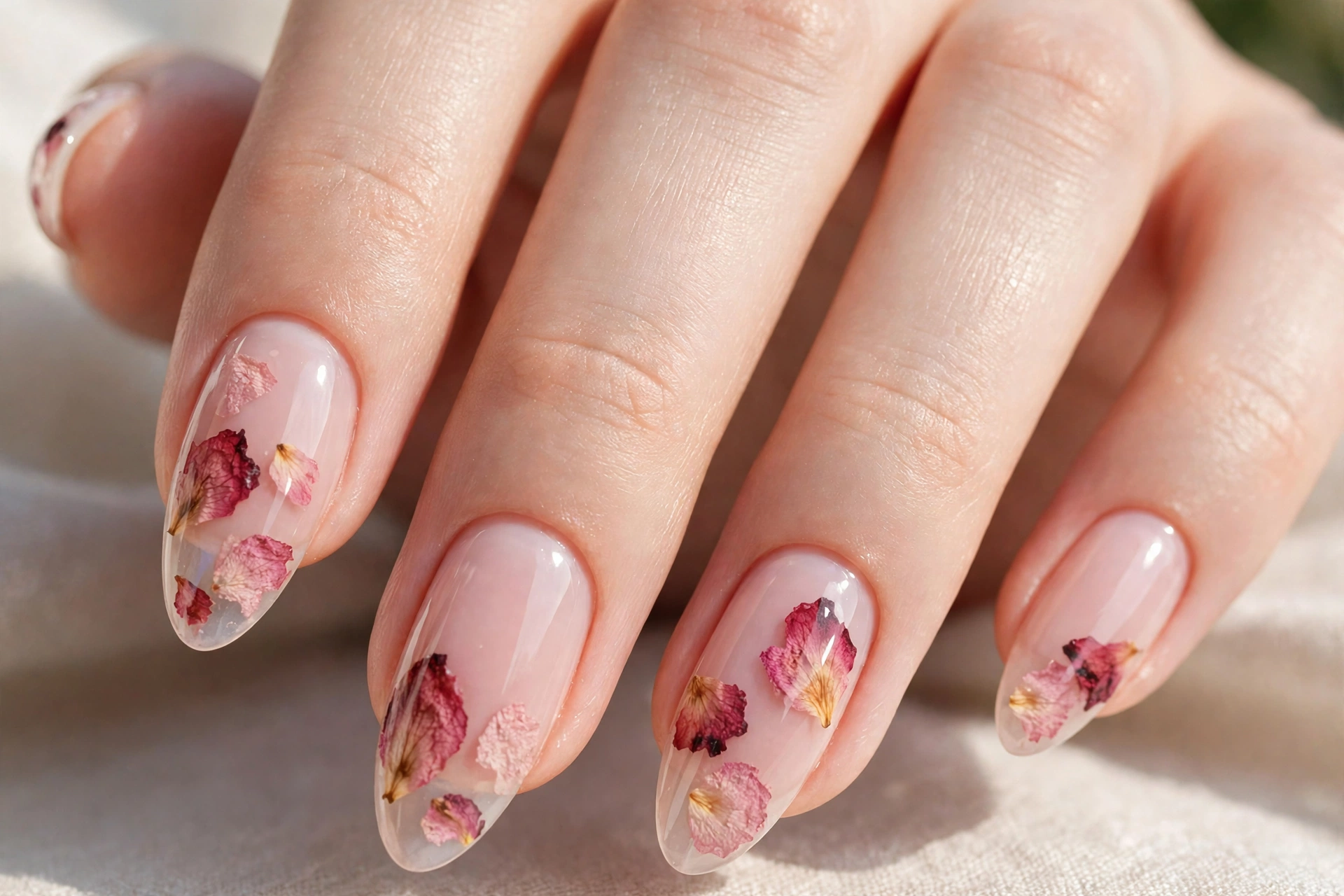
The look: the original milk bath icon — deep rose and blush petals drifting in a milky pink base, like the bath itself poured over your nails. It reads romantic without being childish because the petals are dried, not printed, and their natural veining shows through the gloss.
Shape and length: long almond; length gives the petals room to scatter naturally.
Colors and finish: milky blush pink with rose, wine and soft-pink petals, glossy.
Difficulty: easy at a salon — petals are placed with tweezers, no painting required.
Why choose it: if you want the classic, most-requested version of the trend for Valentine’s season, anniversaries or just a soft-girl era. It flatters warm and cool skin tones equally because the pink base is neutral.
2. Lavender Haze
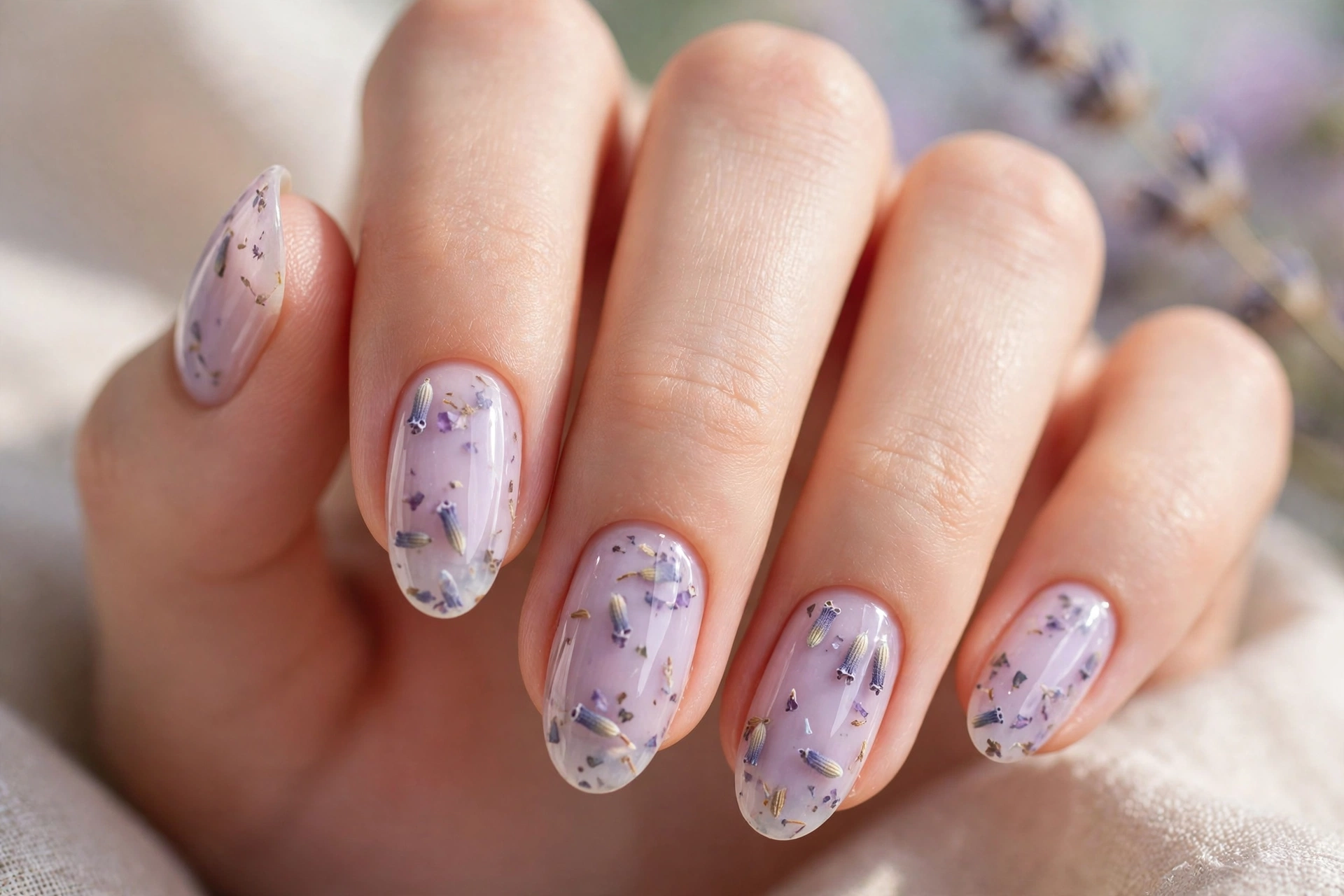
The look: a lilac-milky wash holding real dried lavender buds — cooler and moodier than the pink classics, with a faintly bohemian edge. The purple reads as neutral nail art: present but never loud.
Shape and length: medium almond or oval; the haze effect wants a smooth, curved canvas.
Colors and finish: milky lilac-lavender with dried purple lavender buds, glossy.
Difficulty: easy — small buds are forgiving to place.
Why choose it: for anyone whose wardrobe lives in creams, greys and pastels. Lavender sits between pink and blue, so it pairs with more outfits than either. Also a strong pick if you love the glazed donut softness but want something with more personality.
3. Dried Daisies
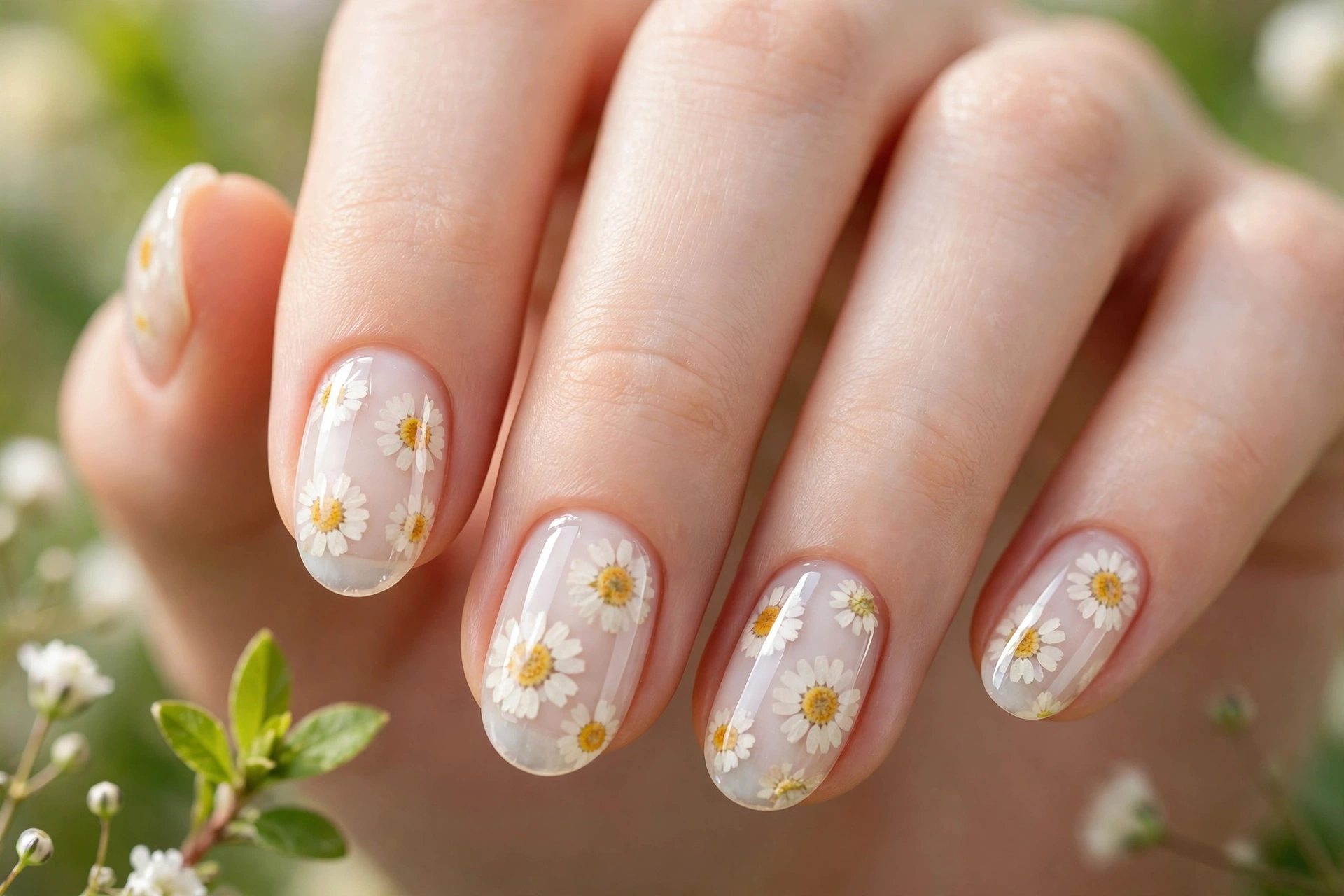
The look: cheerful pressed daisies — white petals, sunny yellow centers — floating in milky white. This is the spring-break version of milk bath nails: fresh, friendly and a little bit retro, like embroidered denim from the seventies.
Shape and length: medium oval; the round petal shapes echo an oval tip.
Colors and finish: milky white with white-and-yellow daisies, glossy.
Difficulty: easy — daisy decals or pressed flowers both work.
Why choose it: when you want florals that feel playful rather than bridal. The yellow centers keep it from reading cold, and it photographs beautifully against spring outfits. Great first milk bath for short-to-medium nails.
4. Baby’s Breath
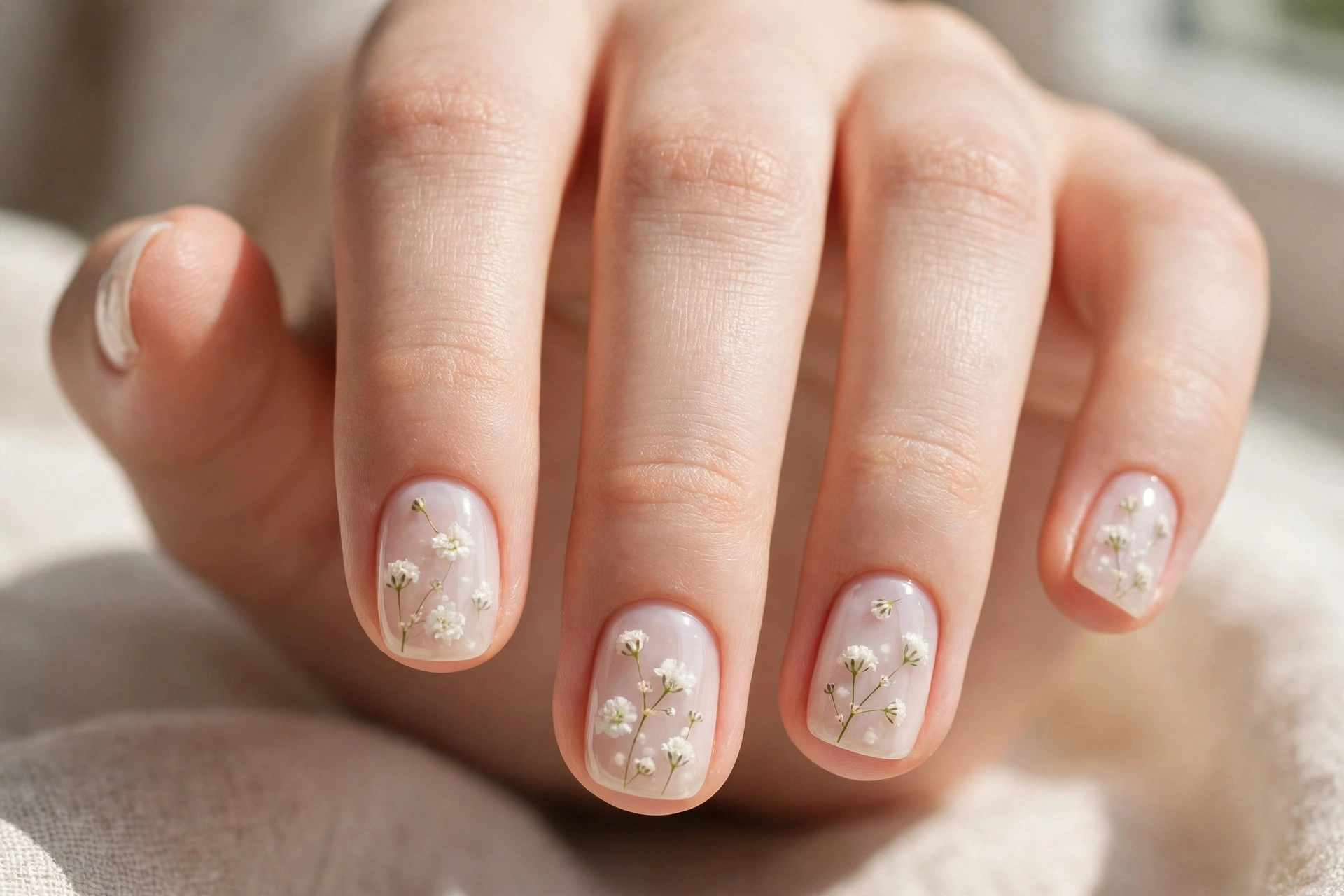
The look: the whisper-quiet one — delicate baby’s breath sprays in a milky ivory base. From across the room it reads as a soft white manicure; up close, it’s an entire tiny garden. This is the minimalist’s answer to floral nails.
Shape and length: short squoval; the fine sprays suit a compact nail and a tidy shape.
Colors and finish: milky ivory with white baby’s breath, glossy.
Difficulty: easy — the stems are so fine that placement barely matters.
Why choose it: bridesmaids, job interviews, conservative offices — anywhere you want nail art that whispers. It’s also the most grow-out friendly of all twenty, since the base is nearly nail-toned.
5. Cherry Blossom
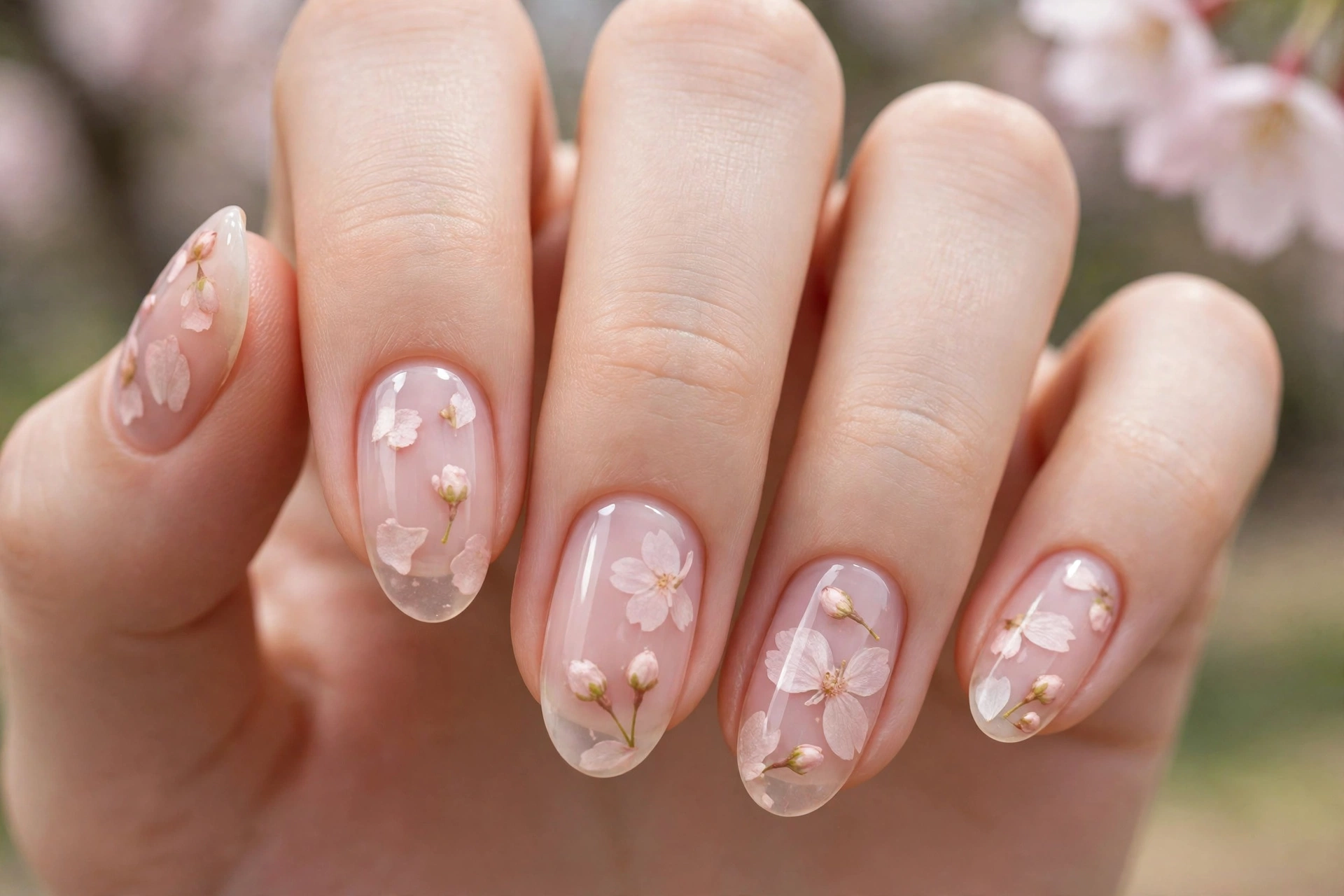
The look: hanami season on your fingertips — pale pink sakura petals and tiny buds drifting in a blush-milk base. More delicate than rose-petal designs because cherry blossoms are smaller and paler, so the overall effect is lighter.
Shape and length: medium almond; tapered tips echo petal shapes.
Colors and finish: milky blush with pale-pink cherry blossom petals and buds, glossy.
Difficulty: easy to medium — petals are thin and need gentle handling.
Why choose it: the definitive spring milk bath. If rose-petal versions feel too romantic for you, cherry blossom is their cooler, crisper cousin. It also pairs gorgeously with the soft pinks of a spring wardrobe.
6. Gold-Foil Milk Bath
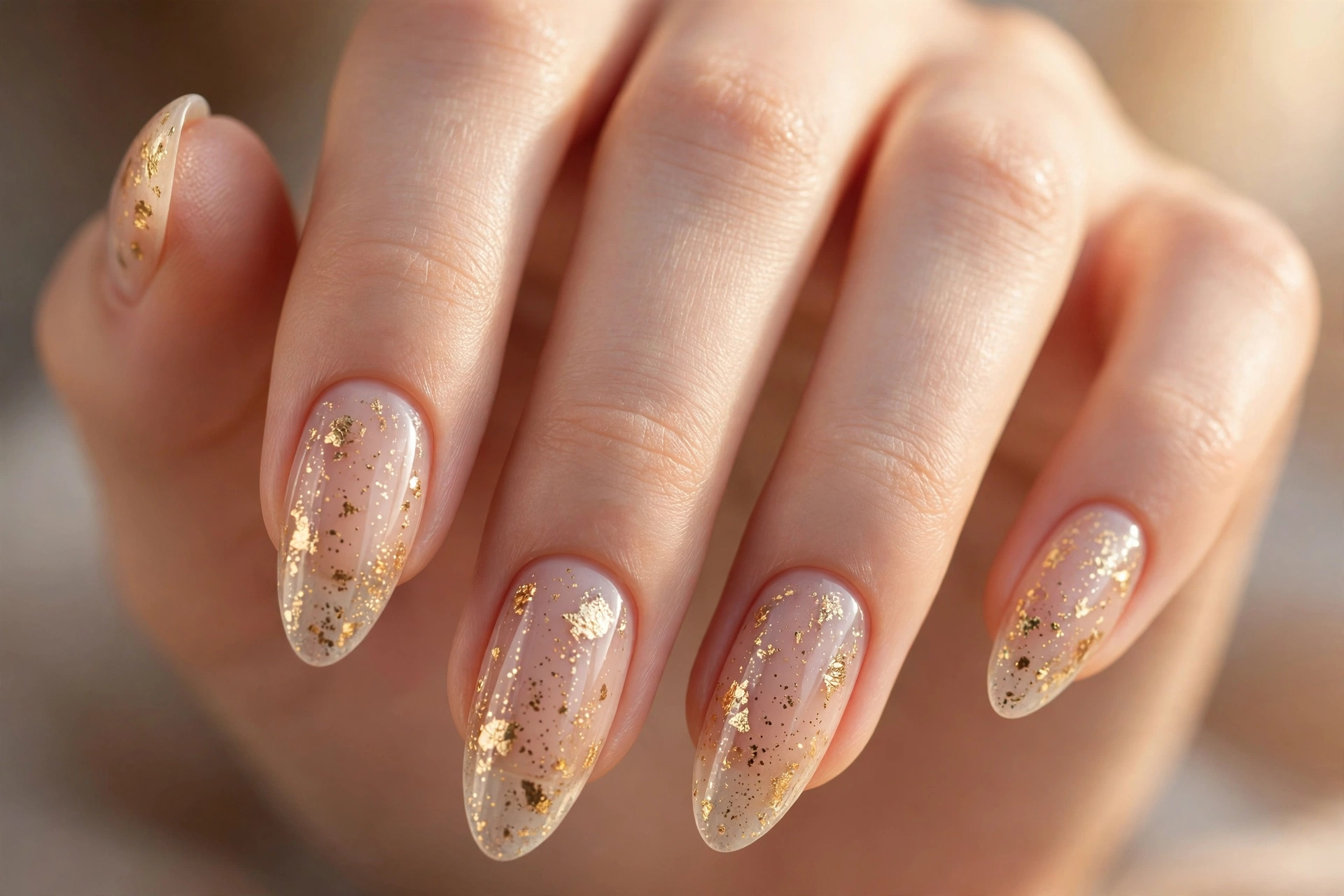
The look: no flowers at all — just fine gold foil scattered through a milky nude base like dust in sunlight. It reads less “garden” and more “jewelry box,” and it’s the version that works best after dark.
Shape and length: long almond; length gives the foil space to drift and catch light.
Colors and finish: milky nude with fine gold foil flecks, glossy.
Difficulty: easy — foil is torn, not painted, and chaos looks intentional.
Why choose it: evenings, holidays and anyone who finds florals too sweet. The gold lifts the milky base from soft to luxe, and it photographs like candlelight. Pair it with the winter nail ideas if you’re building a full holiday look.
7. Autumn Pressed Leaves
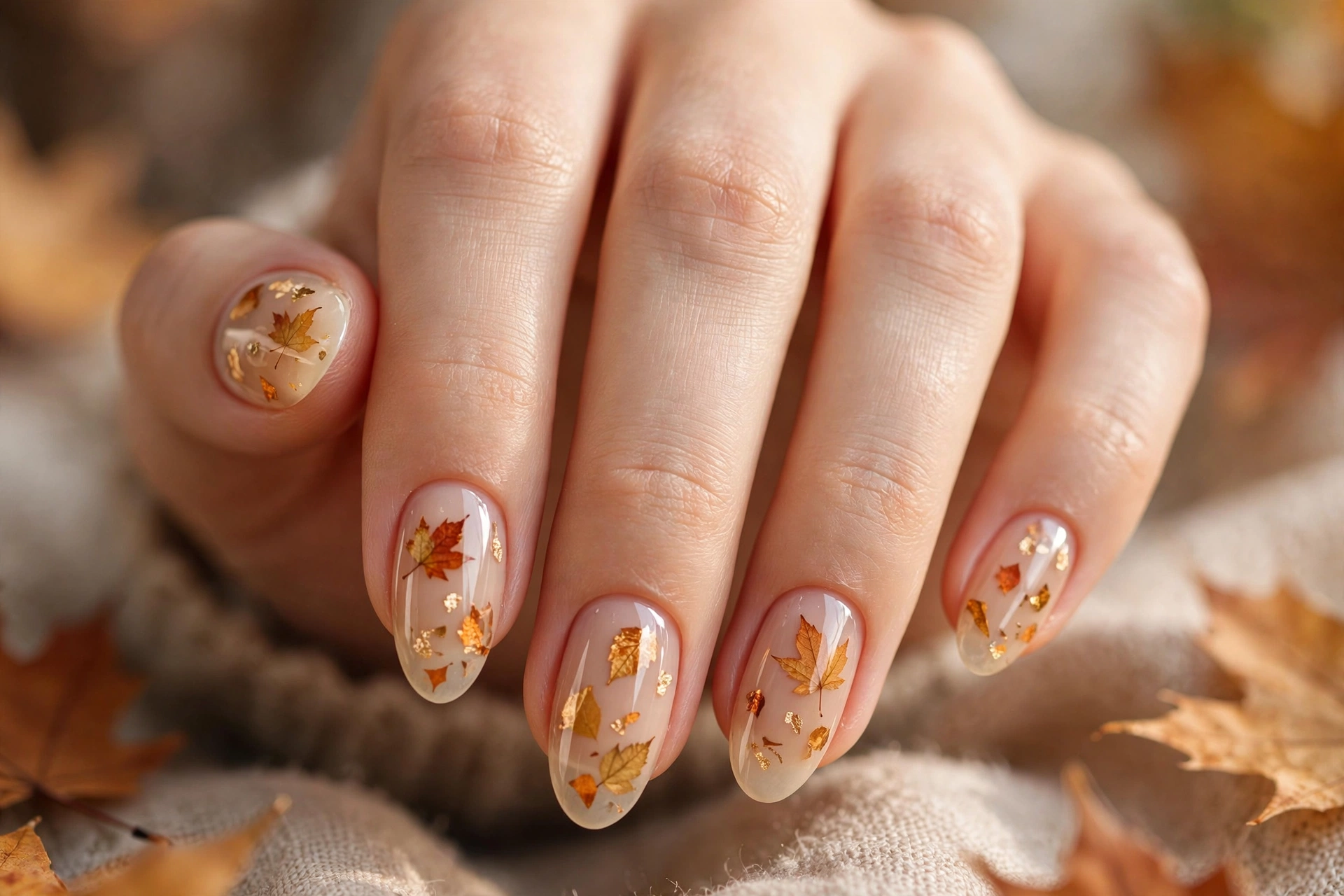
The look: milk bath goes fall — tiny pressed maple leaves in amber, rust and gold suspended in a warm beige-milk base. It carries the same coziness as a chunky knit, but on your nails. See how autumn shades behave in full manicures in our burgundy wine nail designs for fall if you’re building a seasonal rotation.
Shape and length: medium almond or oval.
Colors and finish: milky warm beige with amber, rust and gold leaves, glossy.
Difficulty: medium — leaves are larger than petals and need trimming to fit.
Why choose it: the only milk bath that truly belongs to autumn. If you love fall palettes but find opaque burnt-orange nails too heavy, this is the light-touch alternative.
8. Winter Eucalyptus
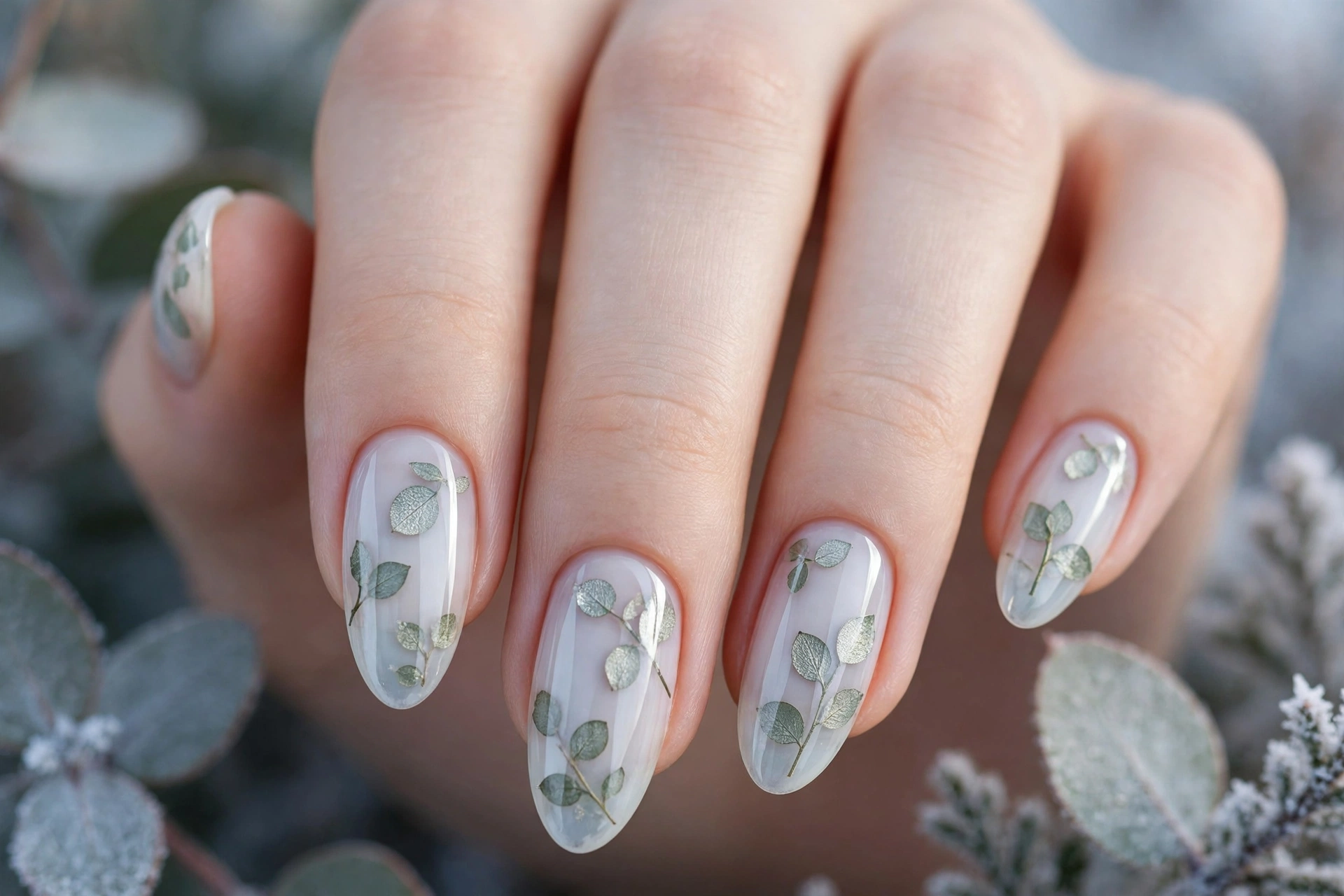
The look: frost in miniature — silvery-green eucalyptus leaves sealed in a cool milky white, like botanicals trapped under ice. It’s the most architectural of the botanical designs, and the only one here that feels wintry without any glitter.
Shape and length: long almond; the leaves’ vertical stems love length.
Colors and finish: milky cool white with silvery-green eucalyptus, glossy.
Difficulty: medium — eucalyptus leaves are stiff and need careful flattening.
Why choose it: winter weddings, December minimalism, or anyone whose style runs cool-toned. The green-silver palette is unusual enough to get compliments and neutral enough to wear with everything.
9. Bridal White Milk Bath
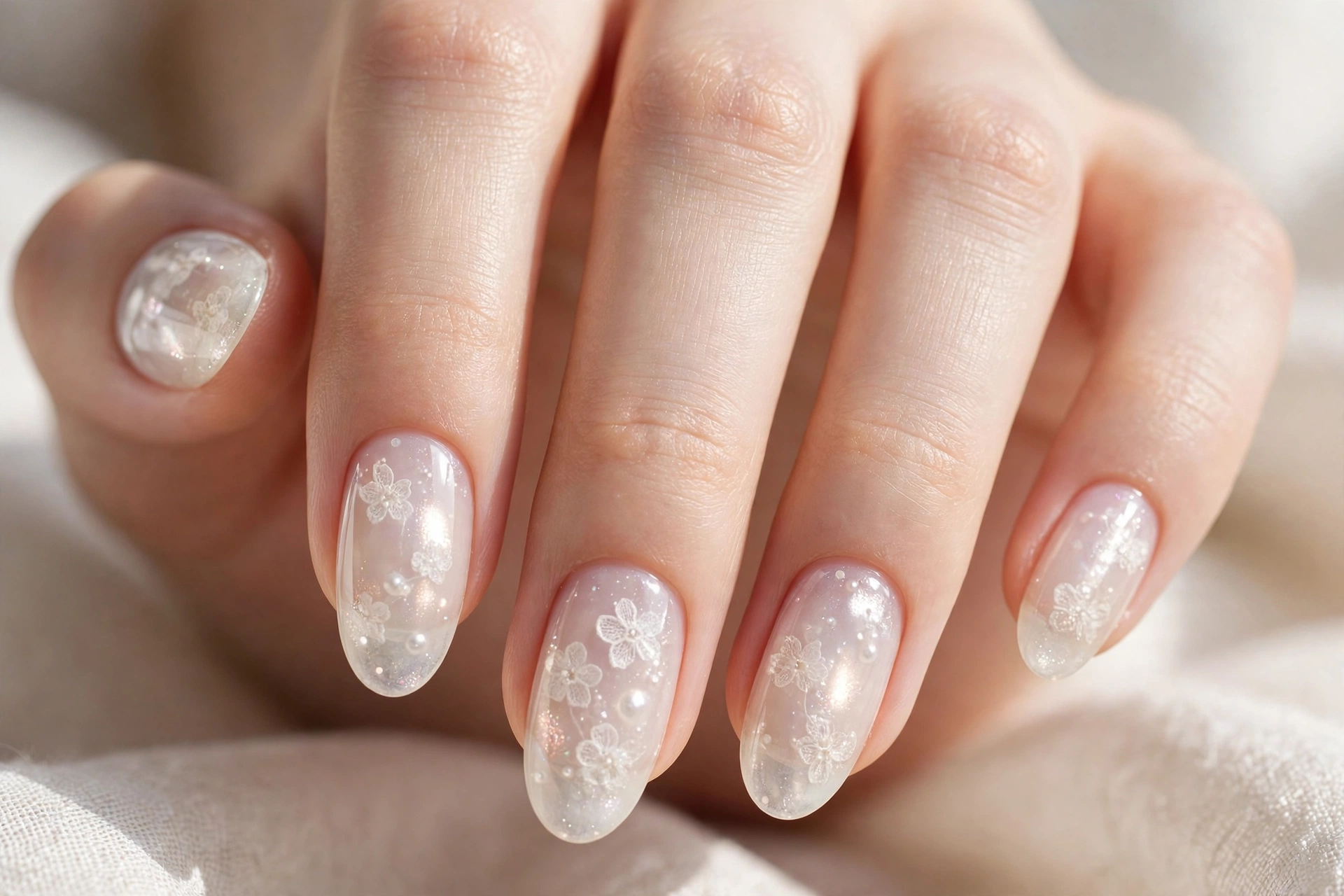
The look: the wedding-day milk bath — lace-fine white blossoms and a breath of pearl shimmer in milky ivory. It photographs as pure luxury: white on white on white, with depth that a flat white polish can never give. For the full wedding-nail decision, our bridal nails planning guide covers timing, trials and finishes.
Shape and length: long oval; the most classically bridal silhouette.
Colors and finish: milky ivory white with white lace blossoms and pearl shimmer, glossy.
Difficulty: medium — the all-white palette shows every bubble, so application needs care.
Why choose it: brides who want florals without color. It matches any bouquet, any dress, and reads “bridal” in photos without screaming it. Also lovely for christenings and formal spring events.
10. Strawberry Milk
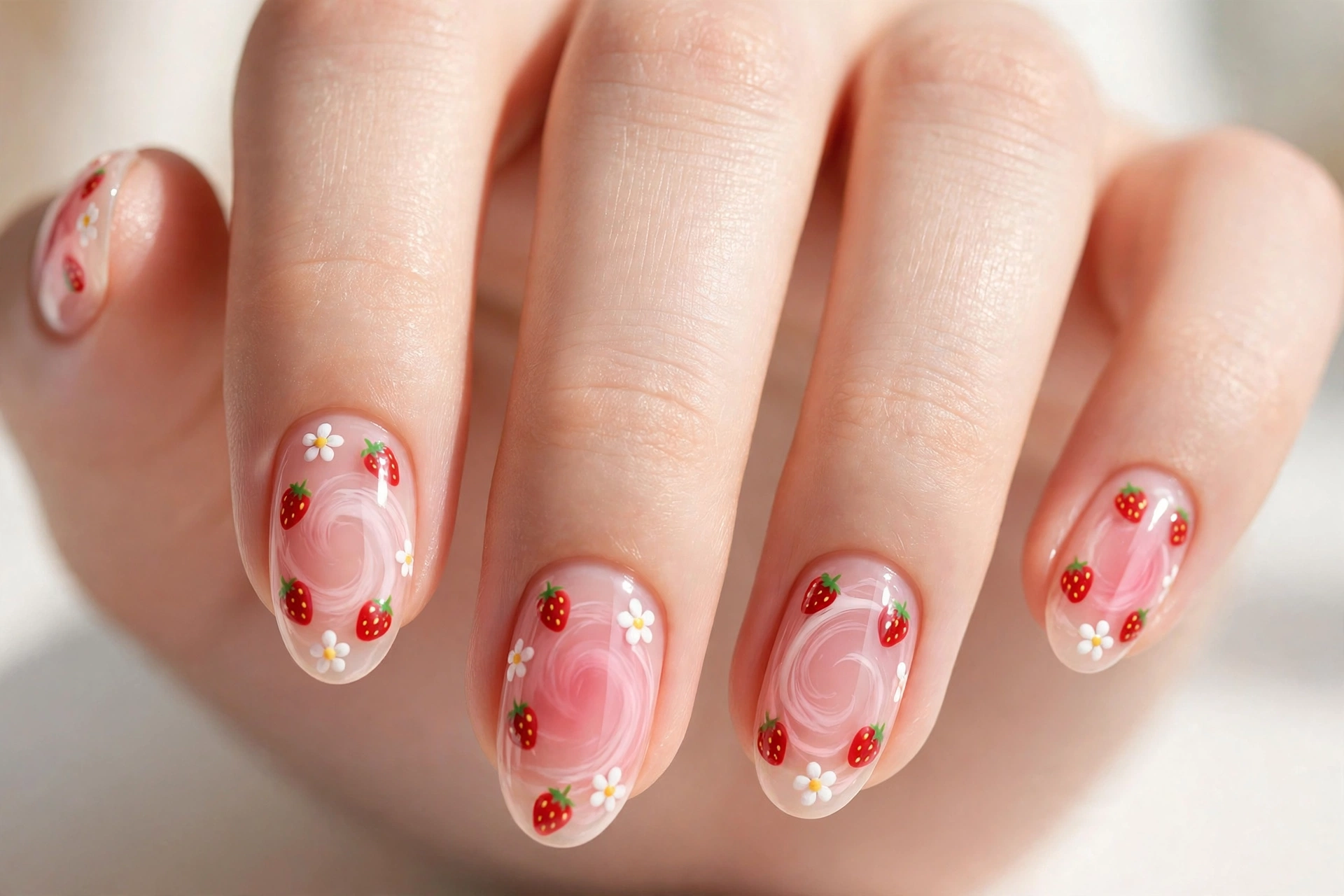
The look: the playful one — a strawberry-milk pink base dotted with tiny red strawberries and white flower accents. It’s the milk bath’s answer to the coquette trend: sweet, a little nostalgic, and impossible not to smile at.
Shape and length: medium almond; the roundness suits the cute motif.
Colors and finish: milky strawberry pink with red and white accents, glossy.
Difficulty: medium — the strawberry dots are hand-painted, then sealed.
Why choose it: when you want your nails to be the fun part of your outfit. It skews younger and more casual than the other nineteen, which makes it perfect for summer, festivals and anyone whose style is more playful than polished.
11. Peach Blossom
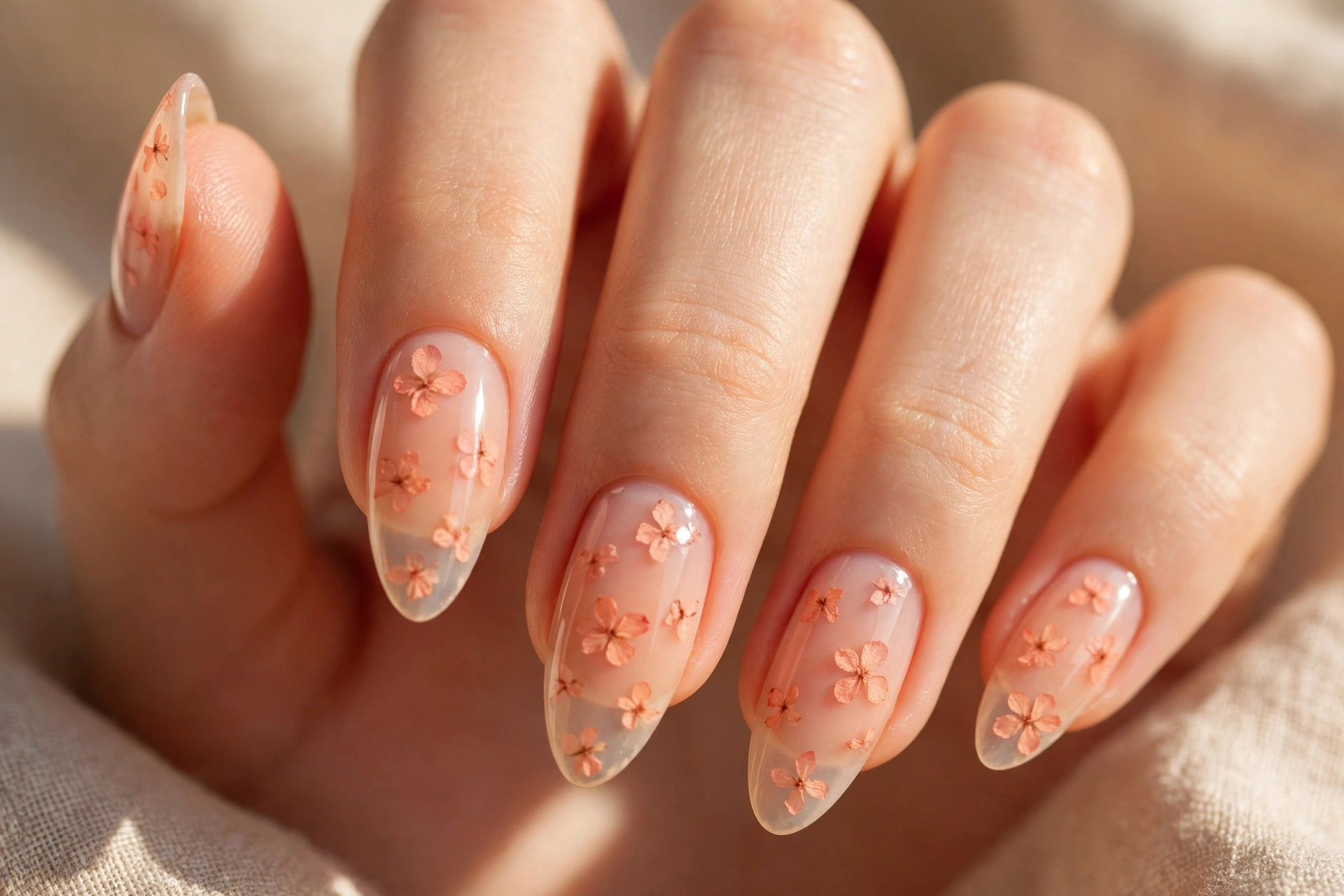
The look: warm where the others are cool — coral-pink peach blossom petals in an apricot-milk base. It glows against the skin in a way the white-based designs don’t, almost like the nail itself is blushing.
Shape and length: long almond.
Colors and finish: milky peach-apricot with coral-pink petals, glossy.
Difficulty: easy to medium.
Why choose it: warm skin tones, golden-hour lighting, late-summer evenings. If milky whites wash you out, peach is your milk bath — it brings the warmth the trend sometimes lacks.
12. Wildflower Meadow
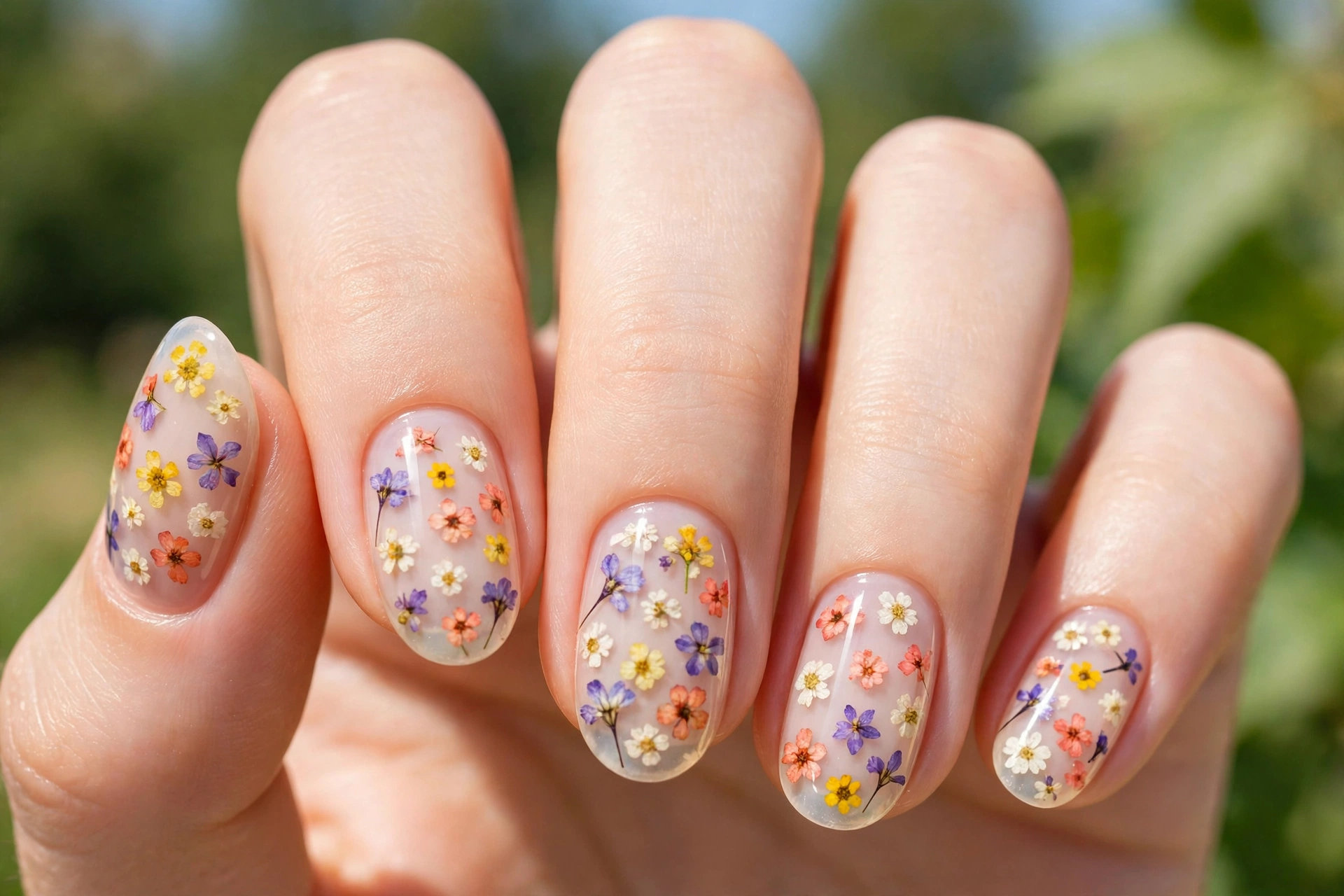
The look: a whole meadow under glass — yellow, violet, coral and white wildflowers scattered through milky ivory. It’s the busiest design in this roundup and proud of it: maximalist milk bath for people who find the minimal versions too quiet.
Shape and length: medium oval; the rounded tip frames the scatter.
Colors and finish: milky ivory with multicolor pressed wildflowers, glossy.
Difficulty: easy — more flowers means less precision needed.
Why choose it: summer holidays, garden parties, dopamine dressing. The color mix means it coordinates with nearly any bright outfit, and no two nails look alike, which is half the charm.
13. Pressed Fern
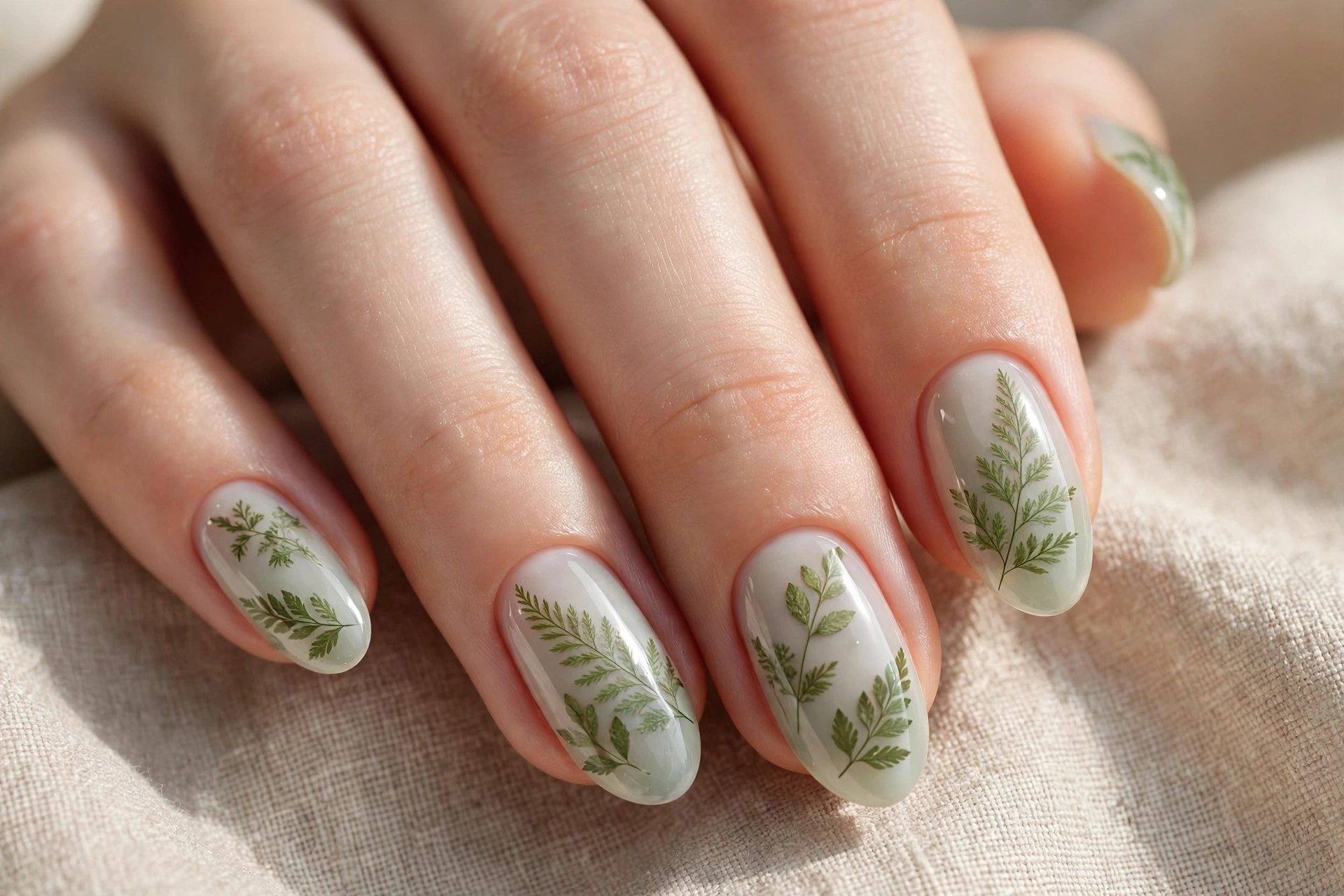
The look: botanical-illustration nails — green fern fronds pressed in a sage-white milk base, like pages from a Victorian herbarium. No petals, no pink: this is the milk bath for people who prefer leaves to flowers.
Shape and length: medium almond; fronds follow the nail’s vertical line.
Colors and finish: milky sage white with green fern fronds, glossy.
Difficulty: medium — fronds must lie perfectly flat.
Why choose it: nature lovers, cottagecore wardrobes, and anyone bored of pink. The green-on-white contrast is striking in a quiet way, and it’s one of the few milk bath designs that reads genuinely unisex.
14. Pink-White Ombre Milk Bath
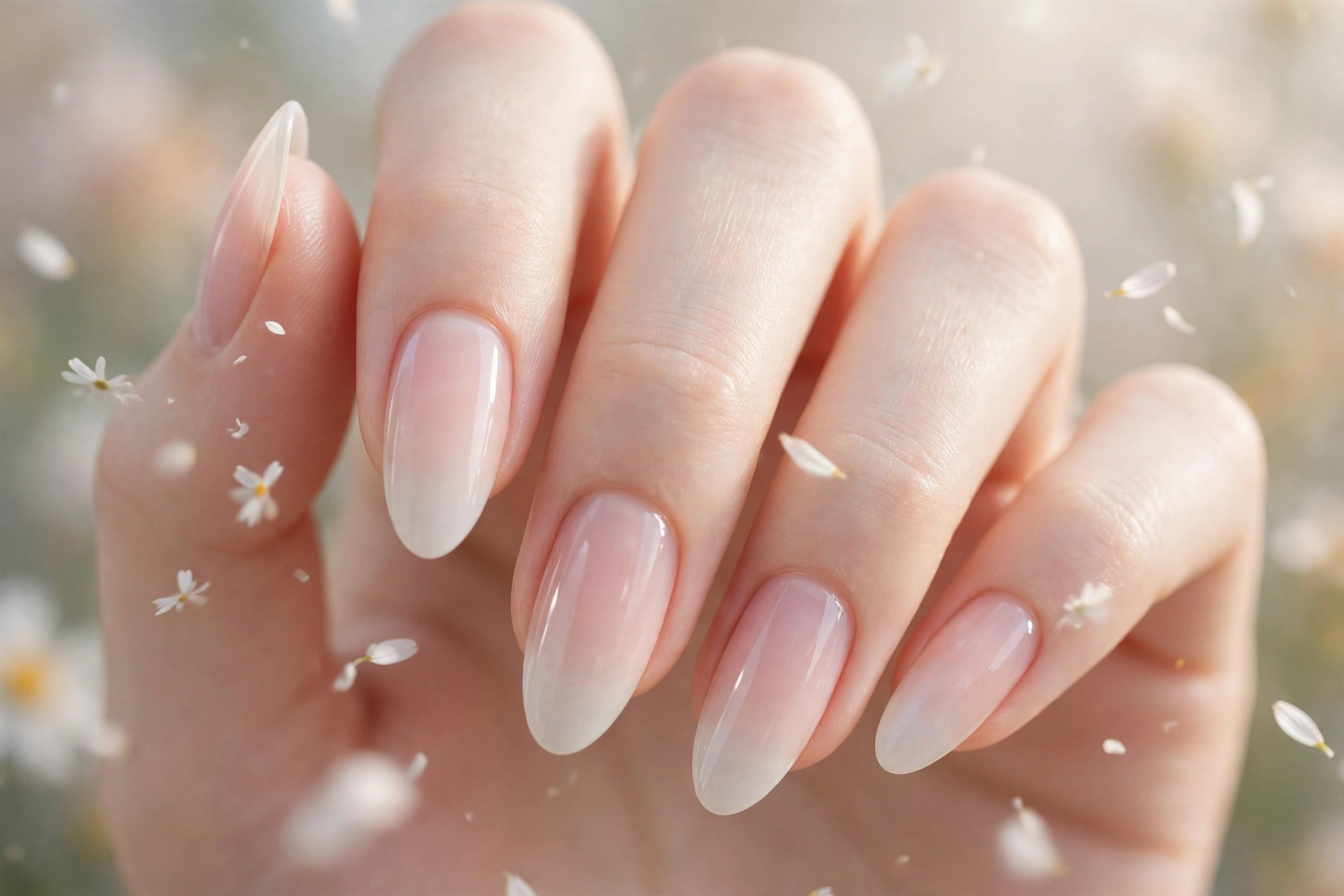
The look: two trends in one — a milky pink-to-white ombre fade with daisy petals drifting through the gradient. It borrows the soft fade logic of baby boomer nails and sets flowers inside it, so the whole nail feels like it’s dissolving into light at the tip.
Shape and length: long almond; ombre needs length to show the fade.
Colors and finish: milky blush fading to milky white, daisy petals, glossy.
Difficulty: medium — the fade is sponged or airbrushed before the flowers go in.
Why choose it: if you can’t decide between ombre and milk bath, stop deciding. The fade also elongates the nail visually, making it a strong pick for shorter nail beds that want a longer look.
15. Gold Flakes
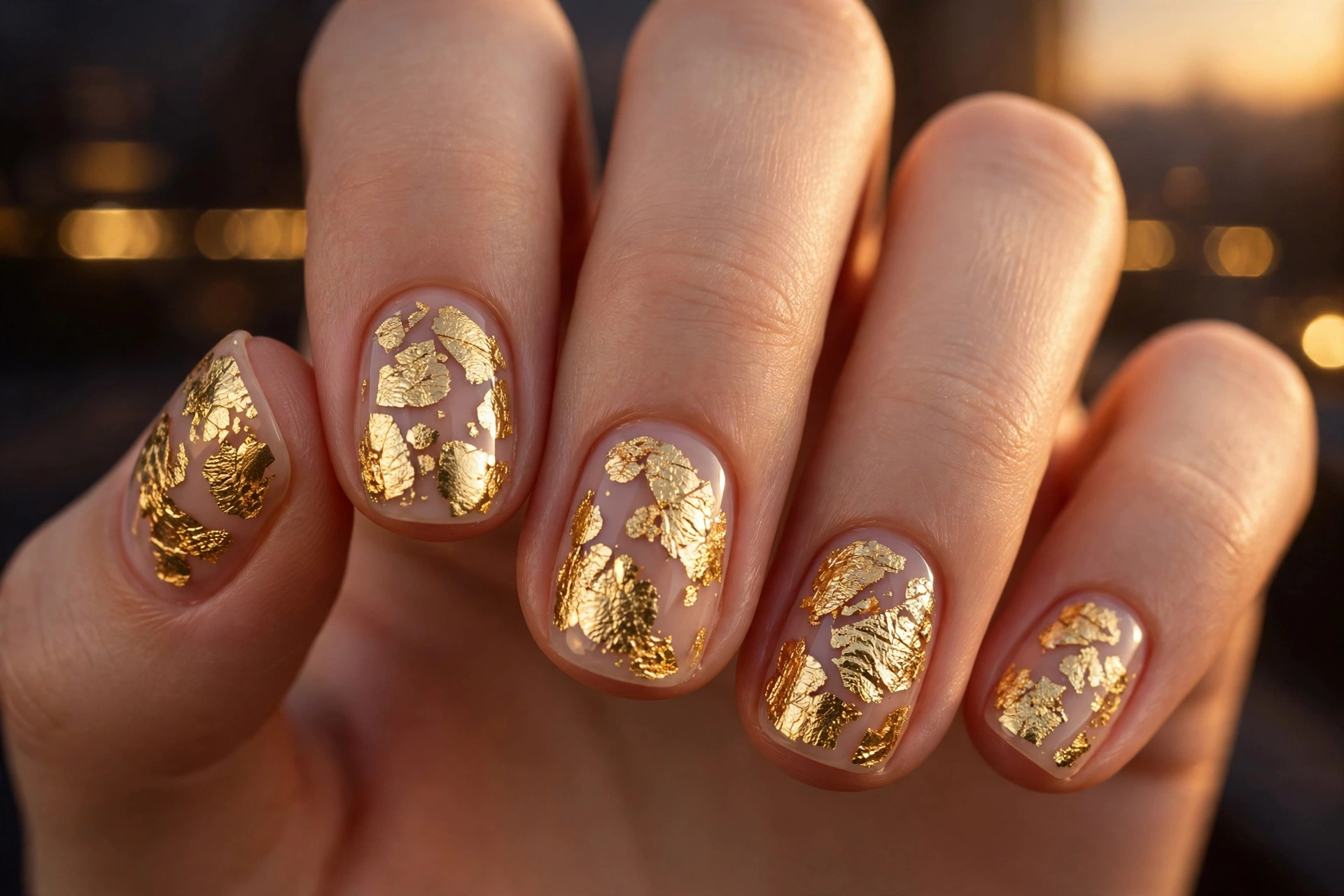
The look: the bolder sibling of the gold-foil design — chunky metallic gold leaf flakes, not fine dust, set in a deeper milky nude. Where number six whispers, this one declares: jewelry-grade shine under a cloudy veil.
Shape and length: short squoval; the compact nail keeps the bold flakes from overwhelming.
Colors and finish: deep milky nude with chunky gold leaf flakes, glossy.
Difficulty: easy — large flakes are the simplest inlay of all.
Why choose it: evenings out, holiday parties, New Year’s Eve. If you want milk bath softness with actual drama, the chunky flakes deliver shine that fine foil can’t. Distinct from the delicate foil version above — ask for “chunky gold leaf,” not “gold foil dust.”
16. Minimalist Single Bloom
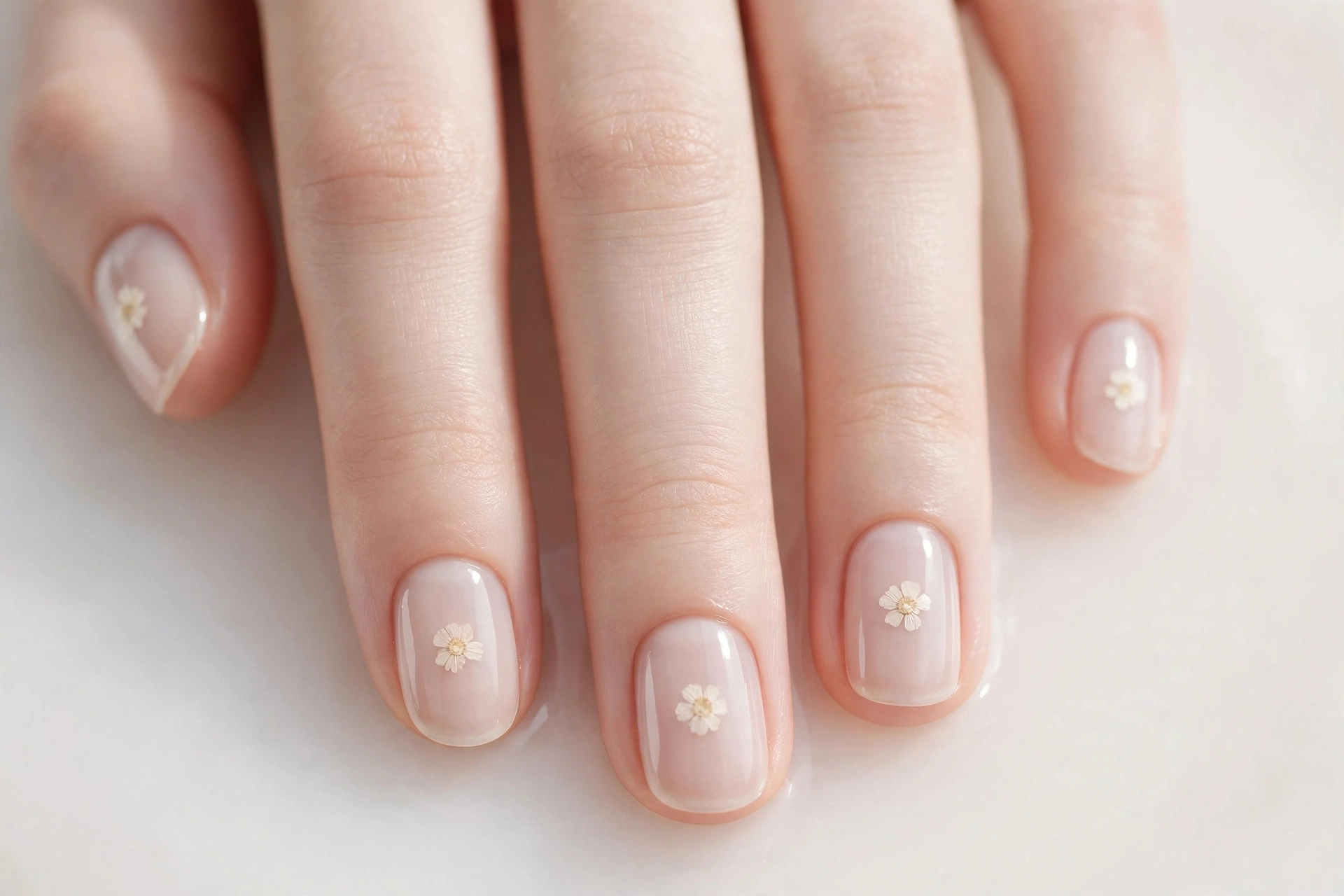
The look: restraint as a design choice — one tiny bloom per nail, centered in a sea of milky neutral. It borrows the negative-space philosophy (our negative space winter guide shows how powerful restraint can be) and applies it to florals: the emptiness is the point.
Shape and length: short oval; small nails suit the single-motif discipline.
Colors and finish: milky neutral with one white bloom per nail, glossy.
Difficulty: easy — the simplest milk bath in this roundup.
Why choose it: the office-safe floral. It satisfies a flower craving without reading as “nail art,” grows out invisibly, and takes a salon minutes. The best starter milk bath if you’re unsure the trend is for you.
17. French Milk Bath
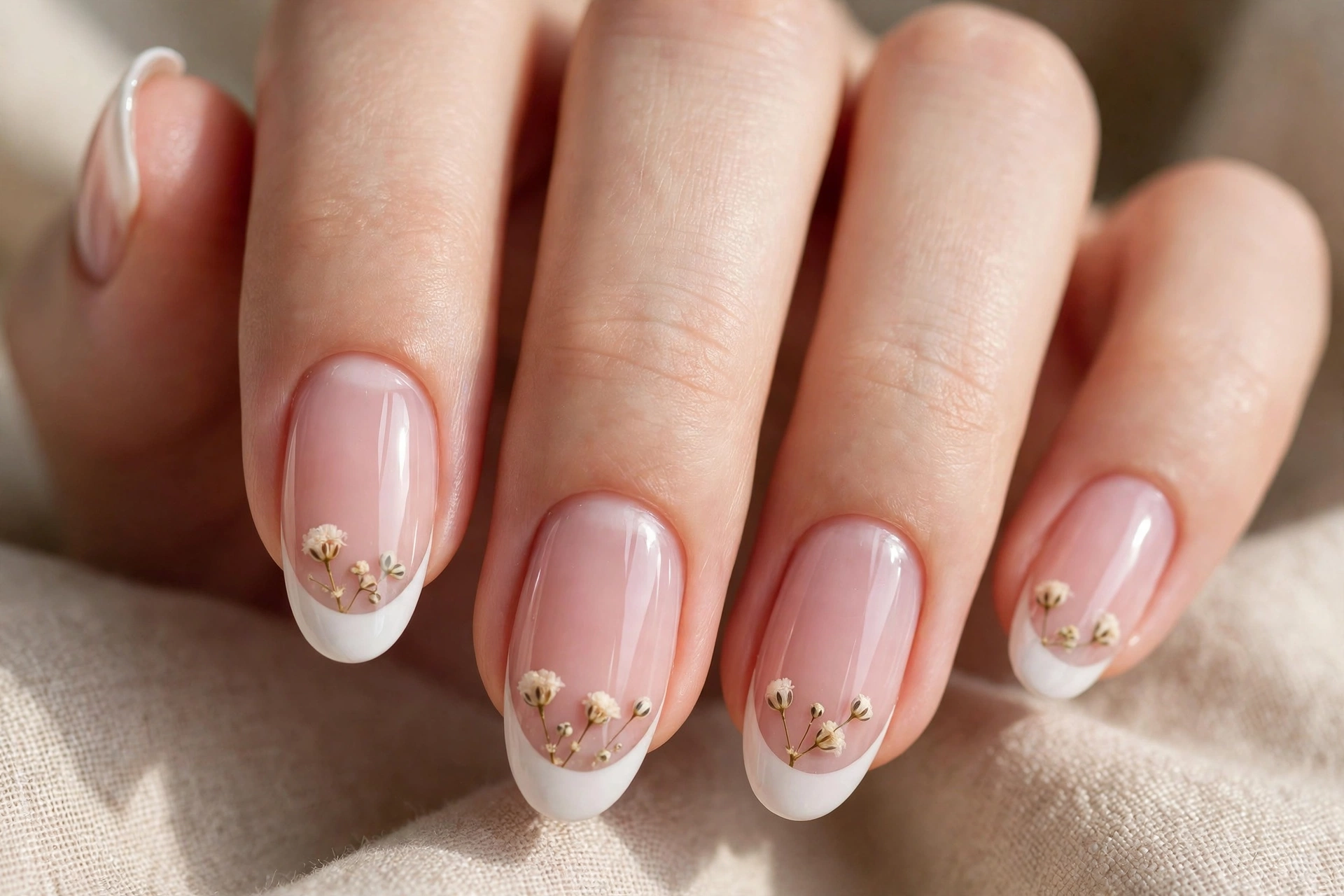
The look: the French manicure’s romantic cousin — white tips over a milky pink base, with baby’s breath tucked just below the smile line. Familiar enough to feel safe, floral enough to feel current.
Shape and length: medium almond; the smile line needs a defined tip to sit on.
Colors and finish: milky pink with white French tips and baby’s breath, glossy.
Difficulty: medium — the French line must be crisp before the flowers go in.
Why choose it: French loyalists who want to try the trend without abandoning their signature. It also suits oval and almond shapes particularly well, since both flatter the curved smile line.
18. Matte Milk Bath
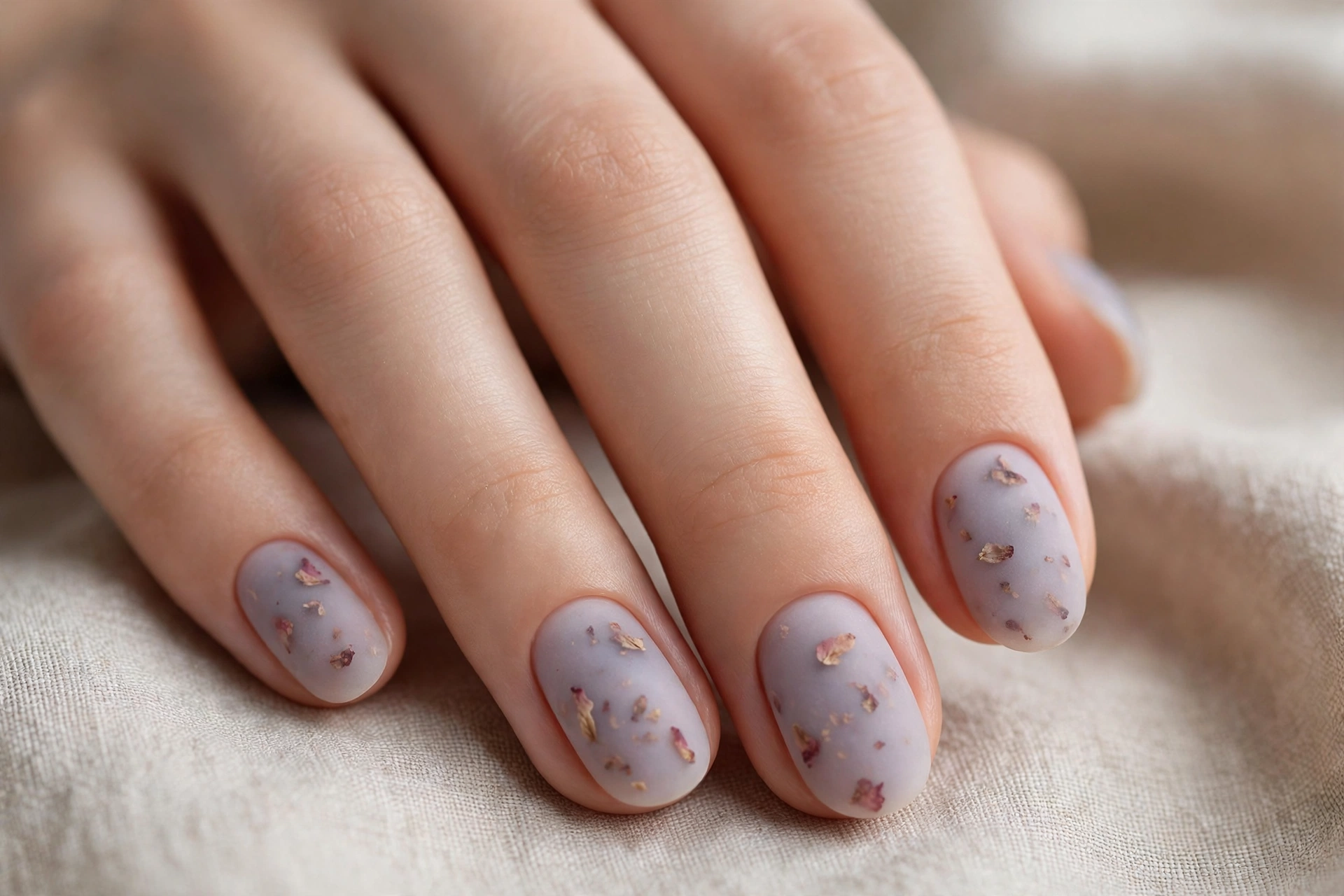
The look: milk bath without the shine — rose petals under a velvety matte lavender-grey veil. Removing the gloss changes the whole mood: softer, more modern, almost like frosted glass. It’s the only matte design here, and it stands out precisely for that.
Shape and length: medium oval; the soft shape matches the soft finish.
Colors and finish: milky lavender grey with dried rose petals, matte.
Difficulty: easy — same inlay technique, matte top coat instead of gloss.
Why choose it: if glossy nails feel too “done” for your style, matte milk bath keeps the florals but drops the formality. Note that matte shows wear faster at the tips, so it’s better for occasions than for a three-week set.
19. Marble-Vein Milk Bath
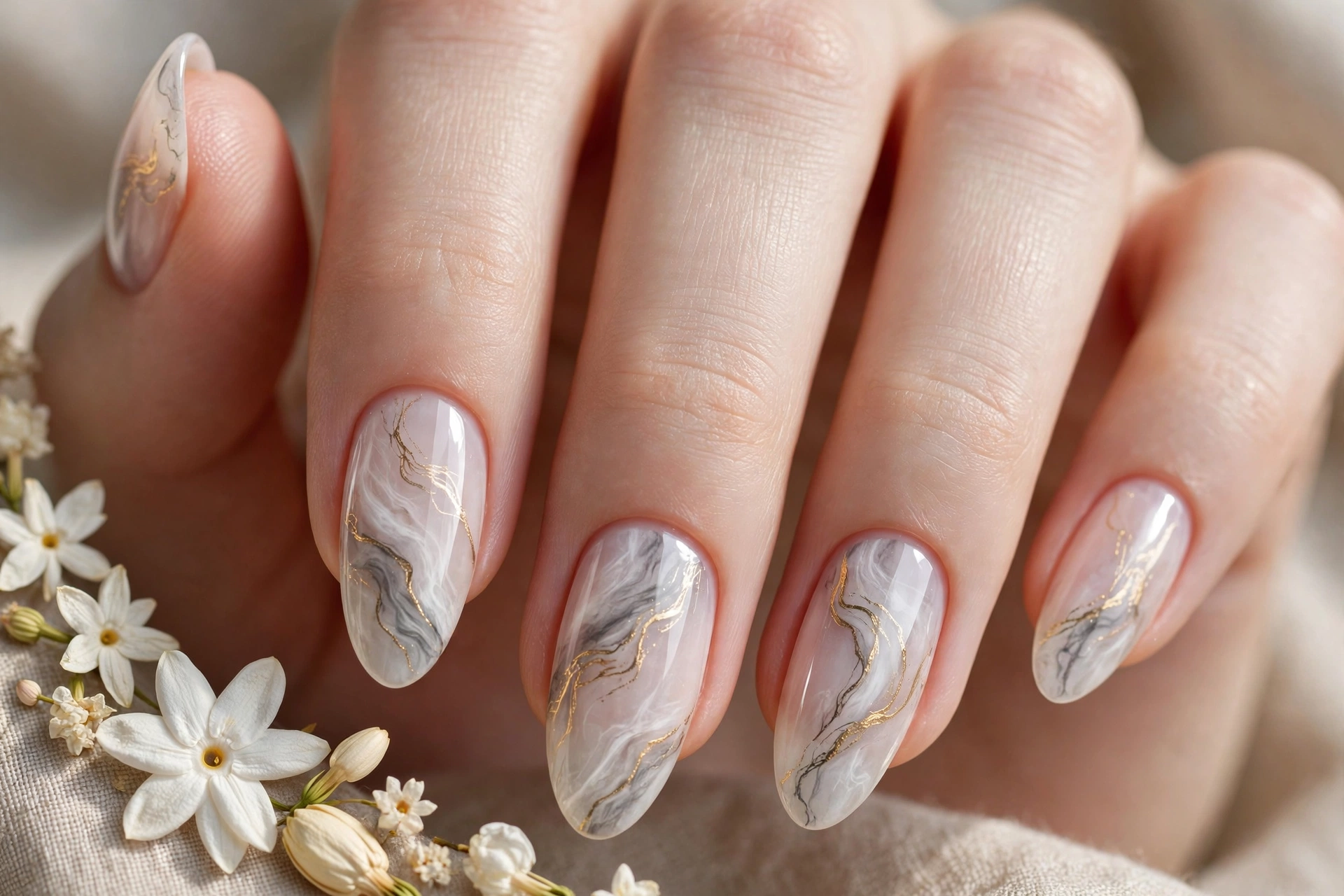
The look: stone meets garden — fine grey and gold marble veins swirled through milky white, with tiny jasmine flowers along one edge. The marble gives the milk bath a structure and luxury that pure florals lack, like a Carrara countertop with petals on it.
Shape and length: long almond; veins need length to flow.
Colors and finish: milky white with grey-gold marble veining and white jasmine, glossy.
Difficulty: medium to hard — veining is the trickiest technique in this roundup.
Why choose it: maximal luxury with minimal color. If your aesthetic is marble bathrooms and gold fixtures, your nails should match. This is also the most “expensive-looking” of the twenty — ask for it when the occasion demands polish with a capital P.
20. Holiday Poinsettia
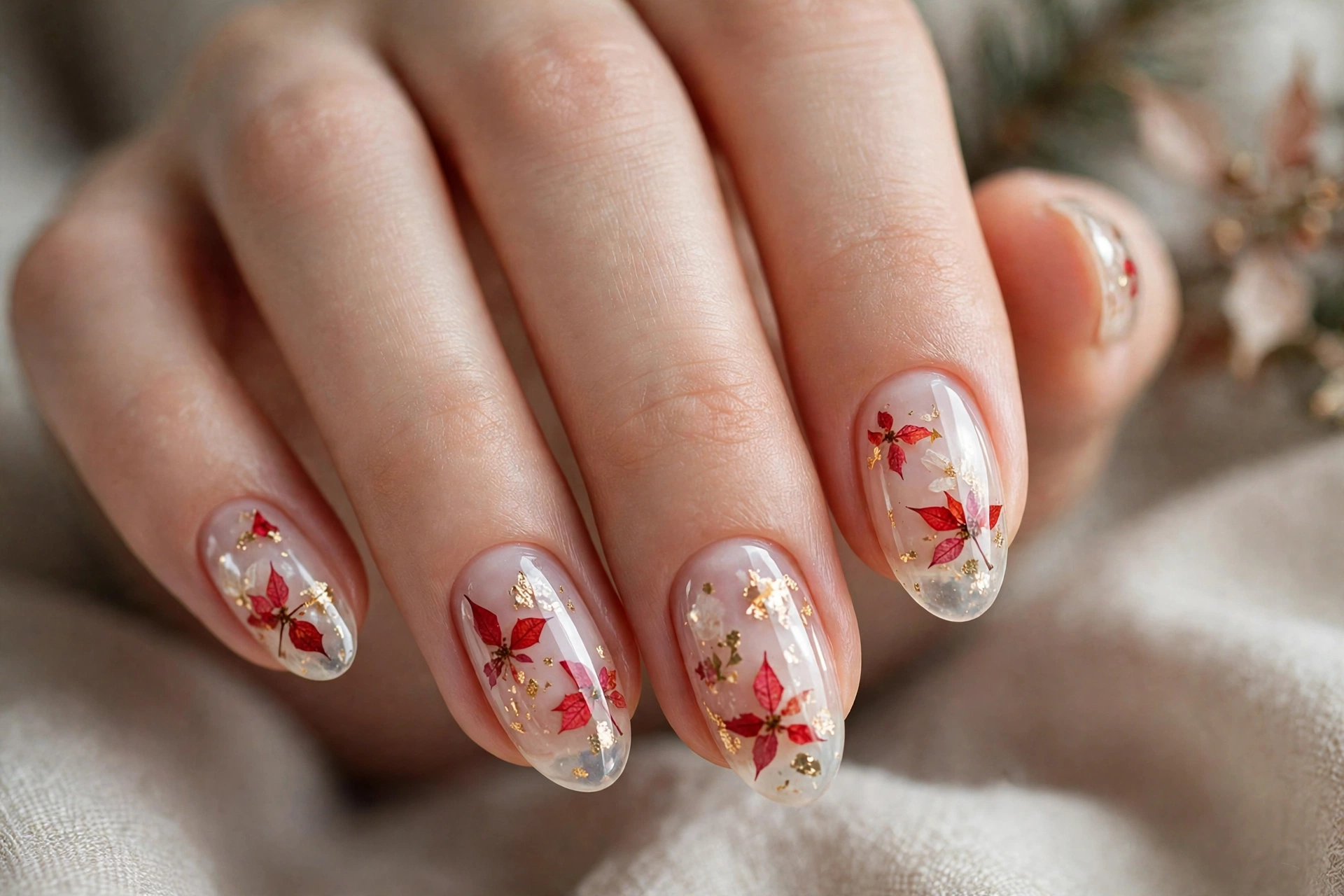
The look: Christmas, but make it milk bath — red poinsettia bracts and gold accents floating in pearl-white milk. Festive without a single snowflake or Santa, which means it works from the office party through New Year’s dinner without feeling costumey.
Shape and length: medium almond.
Colors and finish: milky pearl white with red poinsettia bracts and gold accents, glossy.
Difficulty: medium — bracts are thicker than petals and need a levelled builder layer.
Why choose it: the holiday milk bath. Red-and-gold is the season’s palette, and the milky base keeps it elegant rather than loud. Book it for the second week of December so it’s fresh for the main events.
How do you ask for milk bath nails at the salon?
Ask for “a milky translucent base with dried flowers encapsulated inside,” then show your technician a photo of the specific design you want and name the flower, the base tone and the finish. The technique has no single official name, so precision matters more than terminology. Say: “milky white builder base, pressed rose petals inside, glossy top coat” — or for the bolder looks, “deep milky nude with chunky gold leaf.” Bring the photo on your phone; petals vary, and “milky” means different opacities to different techs. Ask whether they stock pressed flowers or whether you should bring your own (dried-flower nail packs are cheap online), confirm the price — encapsulation usually adds 15–30 minutes and a small upcharge — and request a builder-gel base if you want the set to last three weeks rather than ten days.
How long do milk bath nails last?
With a gel or builder-gel base, milk bath nails last two to three weeks; with regular polish, expect seven to ten days before the milky layers start to wear at the tips. The encapsulated flowers themselves don’t fade or lift — they’re sealed inside the product — so longevity depends entirely on the base system, exactly like any other manicure. The milky finish is genuinely forgiving: because there’s no opaque color line, regrowth at the cuticle shows later than with solid shades, often buying you an extra few days of a presentable set.
Can you do milk bath nails at home?
Yes — milk bath nails are one of the most beginner-friendly encapsulated designs, because placing flowers with tweezers is easier than painting them. You need a milky jelly polish or a sheer white mixed with clear, dried-flower nail stickers or pressed flowers, tweezers, and a glossy top coat. Paint the milky base, place the flowers while it’s tacky, seal with two top coats. The classic beginner mistake is using flowers that are too thick — they create bumps the top coat can’t hide — so start with flat pressed petals or paper-thin dried flowers. A gel lamp and builder gel give a longer-wearing result, but regular polish works for a weekend set.
Milk bath nails — frequently asked questions
Are milk bath nails the same as jelly nails?
No. Jelly nails are translucent colored polish with nothing inside them — think a gummy candy in cherry red or cobalt. Milk bath nails use a cloudy, milky translucent base with dried flowers, petals, leaves or gold foil sealed inside. Both are translucent, but milk bath has visible botanicals floating under the surface while jelly is pure, clean color. Our jelly nails guide covers that finish in detail if you’re deciding between the two.
What nail shape looks best with milk bath designs?
Almond and oval shapes show off milk bath designs best, because their curved, elongated tips give the floating flowers room to read as a composition rather than a cramped cluster. Short squoval works beautifully for minimalist single-bloom versions. Very short or bitten nails can still wear the look — choose tiny flowers and a milky base close to your skin tone. Our nail shapes guide breaks down which silhouette flatters which hand.
Do milk bath nails damage your nails?
Not inherently. The flowers sit inside the product, not on your natural nail, so the technique is no more damaging than any gel or builder-gel manicure. Damage comes from poor removal — peeling or prying off product — not from the design itself. Ask your salon to soak off rather than file aggressively, keep cuticle oil in your routine, and take a one-week break between sets if your nails feel thin.
How long do milk bath nails last?
Two to three weeks with a gel or builder-gel base, or seven to ten days with regular polish. The encapsulated flowers don’t fade or lift since they’re sealed inside the product — wear shows first at the free edge, exactly like any manicure. The milky base hides cuticle regrowth better than opaque color, so the set looks intentional for longer. Cap the free edge carefully during application and reapply top coat mid-week to stretch wear.
Can you do milk bath nails at home?
Yes, and it’s easier than most nail art because you’re placing flowers with tweezers instead of painting them. Use a milky jelly polish or sheer white mixed with clear, flat pressed flowers, and seal with two glossy top coats. Start with paper-thin dried petals — thick flowers create bumps the top coat can’t hide. For a set that lasts weeks rather than days, a gel lamp with builder gel is worth the investment.
What should I ask for at the salon for milk bath nails?
Ask for “a milky translucent base with dried flowers encapsulated inside,” show a photo of the exact design, and name the flower, base tone and finish you want. Confirm whether the salon stocks pressed flowers or you should bring your own, ask for a builder-gel base for three-week wear, and expect a 15–30 minute upcharge for the encapsulation work. Bringing reference photos matters more than terminology — “milky” means different opacities to different technicians.
Milk bath nails earn their place in the trend cycle because they’re genuinely versatile: bridal in white, playful in strawberry pink, architectural in eucalyptus, festive in poinsettia. Pick the design that matches your season and your life, show your tech the photo, and let the flowers do the talking. For more floral and translucent inspiration, browse the nail art gallery — and if this is your first milk bath set, the minimalist single bloom is the perfect place to start.